

The global synthetic-data industry is crowded with tools that promise realism, privacy and scalability. But when it comes to financial data, most solutions fail exactly where financial institutions need precision the most: behavioural logic, temporal consistency, multi-table relationships, and domain-specific modelling.
Northhaven Analytics was built specifically to solve this gap — and this article explains, in technical terms, why our platform delivers what general-purpose competitors cannot.
1. Designed for Finance, Not Adapted to Finance
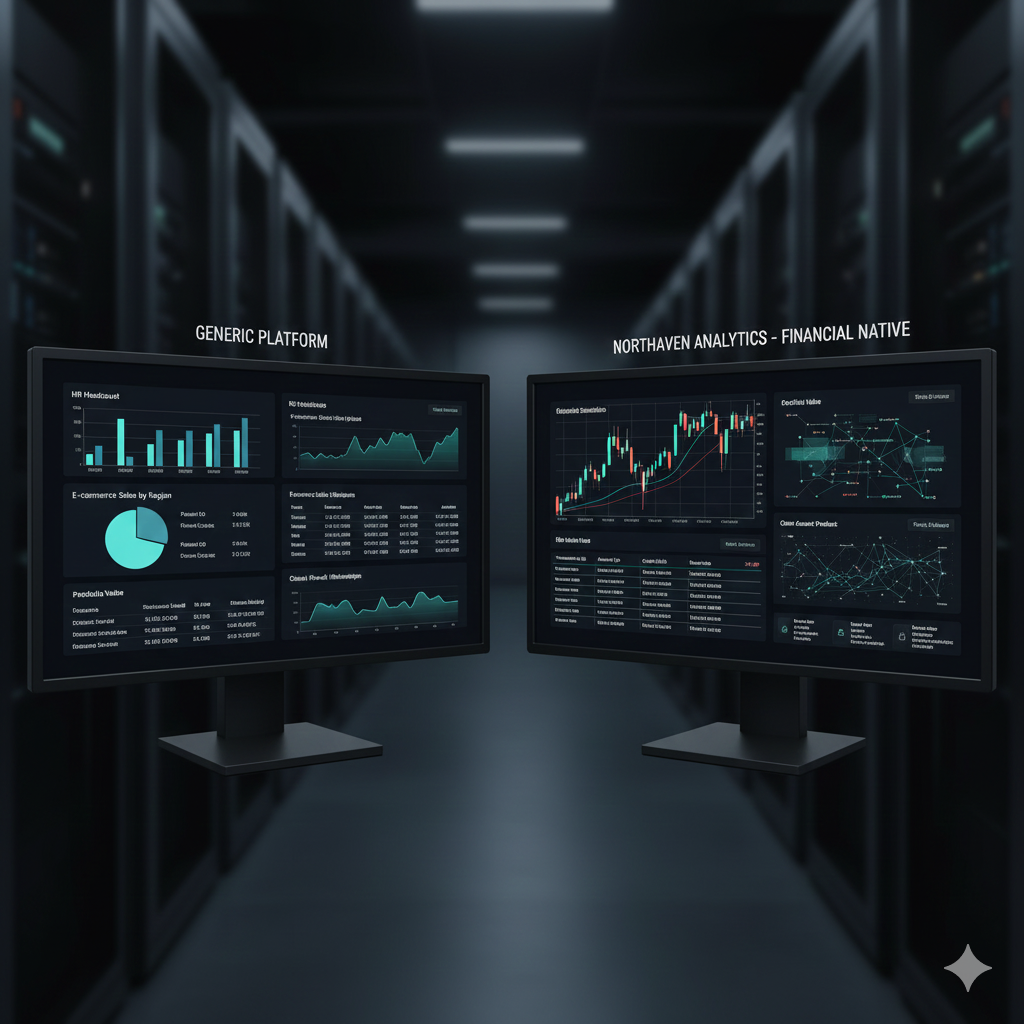
Mainstream platforms (Tonic, MostlyAI, Gretel, Syntho) were built for broad enterprise datasets: HR records, e-commerce tables, healthcare files, CRM systems.
Finance was never their native target.
This leads to structural weaknesses:
- They rely on generic tabular generators.
- They require complex custom logic to simulate financial behaviour.
- They struggle with account–client–transaction relationships.
- They model correlation but not causality.
- They treat time as an afterthought, not a core dimension.
Northhaven is engineered specifically for the financial world.
Every subsystem — from dependency modeling to correlation layering — mirrors real banking logic from the start. No patching, no heavy custom engineering, no workarounds.
2. Our Architecture Is Modular, Not Monolithic
Most competitors operate on monolithic pipelines.
Changing one variable means rewriting the model, retraining engines, or rebuilding internal pipelines.
Northhaven uses micro-modules:
- Variable generators
- Client-behaviour engines
- Product-specific constraint modules
- Temporal simulators
- Anomaly injectors
- Correlation mappers
- Audit & reproducibility layers
Each module can be replaced or extended independently, which means:
- new variables in minutes
- new dependencies without breaking architecture
- custom financial products added instantly
- bespoke ML models for each client without system-wide changes
This is a decisive advantage.
Competitors simply cannot pivot this fast.
3. Continuous-Learning Feedback System — A Feature Others Don’t Have
Most generators produce synthetic data and stop there.
What you get is what you get.
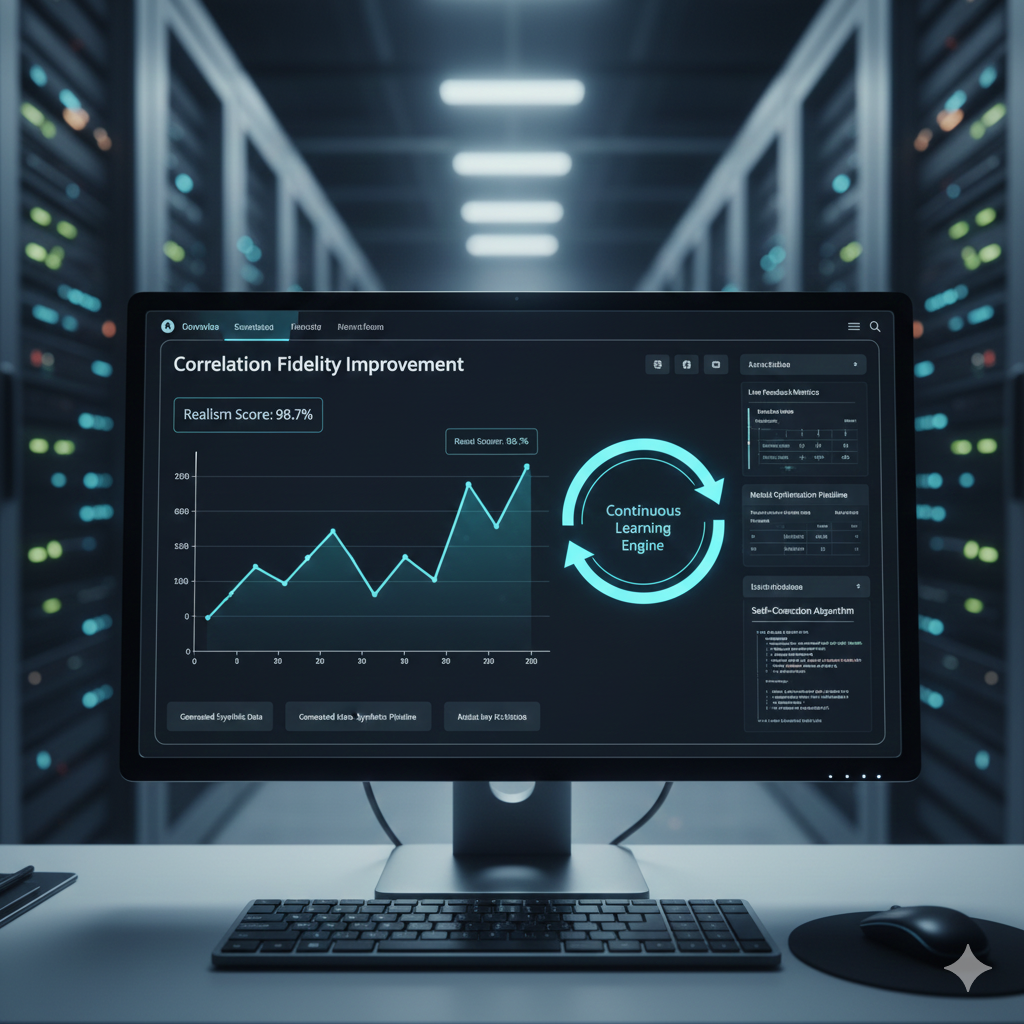
Northhaven runs a feedback engine that uses generated data to continually strengthen:
- correlation fidelity
- behavioural realism
- anomaly boundaries
- temporal patterns
- segment-level consistency
This is extremely rare in the industry.
We don’t just generate data — we generate data that improves the system itself.
Over time, the engine becomes a digital twin of financial reality, not a static generator.

4. True Multi-Table Generation With Real Relational Logic
Competitors often fake multi-table datasets by generating tables independently and joining them afterwards — which breaks:
- account-to-client logic
- product-level consistency
- transaction ordering
- lifecycle dependencies
Northhaven’s engine generates all tables inside a single relational logic graph, meaning:
- consistency is guaranteed by construction
- time and behaviour flow naturally across all entities
- ML models can train on realistic, multi-entity interactions
This is essential for:
- AML
- churn prediction
- credit scoring
- risk modeling
- portfolio behaviour simulation
No competitor delivers this depth out-of-the-box.
5. Constraint-Based Logic: Zero “Impossibles” in the Data
Financial institutions cannot afford unrealistic records.
But most generators create:
- underage loan holders
- negative balances without overdrafts
- inconsistent country/region/currency mappings
- reversed time sequences
- behaviour impossible under real banking rules
Northhaven eliminates this through constraint-first generation, meaning every data point must pass through hard financial logic before it is even allowed to exist.
We don’t clean mistakes after generating data.
We generate data that cannot be wrong.

6. Controlled Anomaly Injection — Critical for AML and Risk Teams
Competitors inject noise blindly.
Northhaven injects behaviourally meaningful anomalies:
- fraud-like transaction clusters
- multi-account laundering patterns
- spending shocks in high-risk segments
- unrealistic overdraft cascades
- correlated anomalies across clients and accounts
Risk teams need rare behaviour, not random behaviour — and that distinction matters.
7. Extreme Speed: Custom Datasets in Minutes, Not Weeks
Most synthetic data solutions require:
- dataset restructuring
- feature engineering
- pipeline retraining
- architectural recomposition
This takes days or weeks.
Northhaven does it in minutes, because:
- every variable is modular
- every generator is plug-and-play
- every dependency is injected dynamically
- every ML model can be built per-client, isolated
This is one of the strongest competitive advantages in the entire industry.
Speed alone puts us in a different category.
8. Custom Machine Learning Models for Every Client
Other companies deliver one global model that tries to fit all industries.
Northhaven builds:
- client-specific generators
- custom dependency graphs
- tailor-made ML models
- dedicated transformations
- unique anomaly patterns
Meaning each institution receives a private synthetic-data engine designed only for their domain and risk structure.
This is why we outperform generic solutions in model accuracy and correlation fidelity.
9. Enterprise-Grade Auditability and Reproducibility
Competitors rarely offer transparent pipelines.
Northhaven provides:
- execution seeds
- full metadata
- reproducibility layers
- model parameters
- rule definitions
- correlation maps
- dependency graphs
Banks need audit-ready artifacts.
We are built for precisely this.
10. Conclusion: Why We Are Unchallenged in Our Category
Northhaven is not “another synthetic data tool.”
It is a financial simulation engine — something fundamentally different in purpose, architecture, and capabilities.
Our competitive dominance is built on:
- financial-native design
- modular architecture
- continuous-learning loops
- behavioural anomaly engines
- real multi-table simulation
- constraint-first logic
- rapid customisation
- client-specific ML models
This is why institutions experimenting with synthetic data eventually discover the same truth:
General-purpose tools can imitate banking datasets.
Only Northhaven can reconstruct them.