The Definitive Guide to Quant Trading: How Synthetic Data Powers Quantitative Trading Strategies and Risk Management
Discover how Northhaven's scenario engine transforms quant trading. We generate synthetic data for quantitative strategies, risk management

By Northhaven Analytics
The landscape of global financial markets has fundamentally shifted. The era of the discretionary trader relying on gut instinct is fading. In its place, quantitative trading has risen to dominance, driven by massive computational power and advanced data science. For the modern quant trader working at a top-tier trading firm or hedge fund, the competitive edge is no longer just about speed—it is about the fidelity of the market data used to train predictive models.
At Northhaven Analytics, we understand that to execute trades with precision, investment firms need more than just historical backlogs. They need synthetic financial datasets and a robust scenario engine. This guide explores the depths of quantitative finance, the tools quant traders use, and how our infrastructure allows you to generate the future of algorithmic trading.
The Evolution of Quantitative Trading: From Thorp to AI-Driven Trading Systems

The history of quantitative trading is a story of mathematics conquering the trading floor. It began with pioneers like Edward Thorp, one of the first quantitative investors who applied probability theory to the market. Thorp proved that a rigorous quantitative discipline could identify profitable trading anomalies that traditional analysis missed.
Today, quantitative analysis is the engine room of institutional investors and hedge funds. A quantitative analyst (or “quant”) builds complex mathematical and statistical models to scan thousands of securities simultaneously. Major firms like Renaissance Technologies or Bridgewater Associates have industrialized this approach.
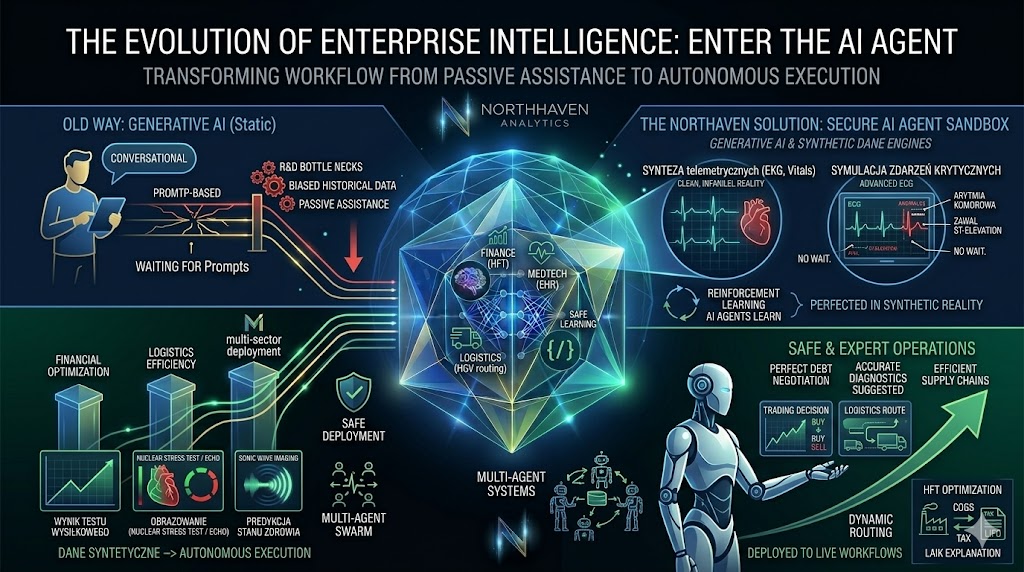
However, the modern quantitative trader faces a new challenge. Historical data is finite. Financial markets are non-stationary. To learn quantitative trading strategies that survive a crisis, you cannot simply look at the past. You must use computational finance to simulate what could happen. This is where the Northhaven solution redefines the quantitative subject. By utilizing a custom scenario engine, quant teams can create plausible alternate realities to test their trading strategies.
Core Quantitative Trading Strategies: Enhancing Statistical Arbitrage and Automated Trading
Quantitative trading strategies are diverse, but they all rely on data points to make decisions. To become a quant capable of generating alpha, one must master several distinct approaches. Strategies include:
1. Statistical Arbitrage and Pairs Trading
Statistical arbitrage is the bread and butter of many hedge funds. It involves identifying a group of similar stocks or assets that historically move together. When their prices diverge, the mathematical model signals to buy and sell—buying the underperformer and selling the overperformer. However, statistical models trained only on historical data often fail during regime shifts. Northhaven allows you to transform your datasets to simulate correlation breakdowns. By injecting synthetic noise, you can verify if your arbitrage logic holds when the market structure fractures.
2. High-Frequency Trading (HFT)
In high-frequency trading, algorithms are used to transact orders in microseconds. Automated trading systems scan for minute price discrepancies across different exchanges. Here, the trading systems must be incredibly robust. Using our simulator, HFT firms can test their trade execution logic against synthetic liquidity crunches, ensuring their algo doesn’t crash when order books thin out. We allow you to simulate a scenario where a user attempts to transfer more than 200.000 units of liquidity in milliseconds, testing the resilience of your execution stack.
3. Trend Following and Momentum
Many quant traders employ trend-following strategies. These quantitative strategies assume that assets which have performed well in the past will continue to do so. However, quant traders may face “whipsaws” in volatile markets. Our scenario generation tool helps quant teams visualize how momentum signals decay under varying volatility regimes.
Why Traditional Quantitative Trading Fails: The Data Bottleneck
To build profitable opportunities, a quant trader’s primary resource is data. Yet, accessing high-quality financial data is the biggest bottleneck in financial engineering.
Real financial data is often sparse. Tail events (Black Swans) happen too infrequently to train robust machine learning models. Furthermore, strictly relying on data mining of past events leads to overfitting—where a model memorizes history but fails in the future. Northhaven’s synthetic financial datasets solve this. We allow you to use quantitative methods on augmented data. Our data generator creates plausible market conditions that maintain the statistical properties of real assets—volatility clustering, fat tails, and correlation breakdowns—allowing you to develop more resilient trading strategies.
Consider the emerging mobile money transactions domain. A mobile financial service might want to detect fraud or predict flow. A real transaction dataset is difficult to access due to strict privacy regulations. Northhaven generates synthetic logs where an illegal attempt in this dataset (like a 200.000 in a single transaction structuring scheme) can be modeled and detected without using PII.
The Scenario Engine in Quantitative Trading: Simulating the Future

Traditional risk management often relies on legacy software—monolithic applications like the metaphorical scenarioengine.exe running on a local server. These tools are rigid. They look backward. They cannot handle the complexity of modern electronic trading.
Northhaven offers a custom scenario engine that is cloud-native and integrates directly with your SQL Server or data lake via API. This module allows you to configure and generate thousands of future market states instantly.
Why is this crucial for a Quantitative Trader?
Historical data is a single sample path of what could have happened. It does not capture the full distribution of risk. Quantitative finance demands more. By using our tool for scenario generation, you can:
- Explore tail risks that exceed historical precedents.
- Train AI models on synthetic bear markets, ensuring your trading systems are antifragile.
- Manage portfolio exposure dynamically based on plausible future correlations.
- Report on scenario’s outcomes to investment committees with higher confidence.
This method of simulation gives investment firms a significant advantage. Instead of reacting to a market shock, they have already simulated it.
Optimizing the Quant Trader Workflow: From Python to Trade Execution
The modern workflow of a trading firm is highly automated. Sales and trading desks are increasingly relying on electronic trading platforms driven by quantitative analysis.
Northhaven’s infrastructure is built for this automation. Data scientists can pull synthetic data directly into their Python environments to perform backtesting. Once a model to identify alpha is validated, it can be deployed into automated trading production pipelines.
Quantitative trading uses vast amounts of data. Data mining techniques are applied to find signals in the noise. However, using quantitative analysis on limited datasets leads to overfitting. Our data generator solves this by providing augmented datasets that improve the generalization of learning algorithms. Whether you are using statistical methods or advanced deep learning models, the quality of your input data determines your trade success.
Risk Management in Quantitative Trading: Surviving Market Crises
For a hedge fund manager, generating alpha is only half the battle. Keeping it is the other half. Risk management in quantitative trading involves measuring Value at Risk (VaR) and Expected Shortfall.
Quant traders may underestimate risk if they only look at the last 500 trading days. Statistical analysis of synthetic scenarios provides a more honest view of leverage and liquidity risk. Quant strategies that appear profitable trading opportunities in a backtest can often blow up in a real liquidity crisis.
Northhaven’s core technology allows you to stress-test your hedge effectiveness. Does your hedge actually protect the portfolio when correlations go to 1? Our interactive dashboard and reports provide the answer. We allow you to verify if a dataset is an attempt to deceive your model or a genuine signal.
How to Become a Quant: The Skills Required for Modern Quantitative Trading
The definition of a quantitative trader is expanding. It now includes expertise in the financial markets, advanced computer programming, and deep knowledge of machine learning.
Quant traders usually have a master’s degree in a quantitative subject like physics, math, or computer science. But even the best data scientists are limited by the data available to them. This is where the Northhaven solution bridges the gap. We provide the computational sandbox where new strategies can be tested without risking capital.
Trading involves uncertainty. The goal of quantitative finance is to quantify that uncertainty. Institutional investors and hedge funds are moving towards AI innovation, where data comes from generative sources like Northhaven to fuel large language models and predictive engines.
Conclusion: The Future of Quantitative Trading Systems
The trading floor of the future is silent. It is run by automated trading systems and monitored by data scientists and financial institutions that value robust infrastructure. To compete, a trading firm must adopt new strategies for data acquisition and validation.
Quantitative finance is evolving. Computational finance is now synonymous with generative AI. Whether you are involved in sales and trading, electronic trading, or pure quantitative research, Northhaven Analytics provides the dataset and the engine you need to build profitable opportunities.
We help you buy and sell not just on signals, but on verified, stress-tested intelligence. Don’t let your analysis be limited by the past. Use Northhaven to generate the future of your investment strategy.