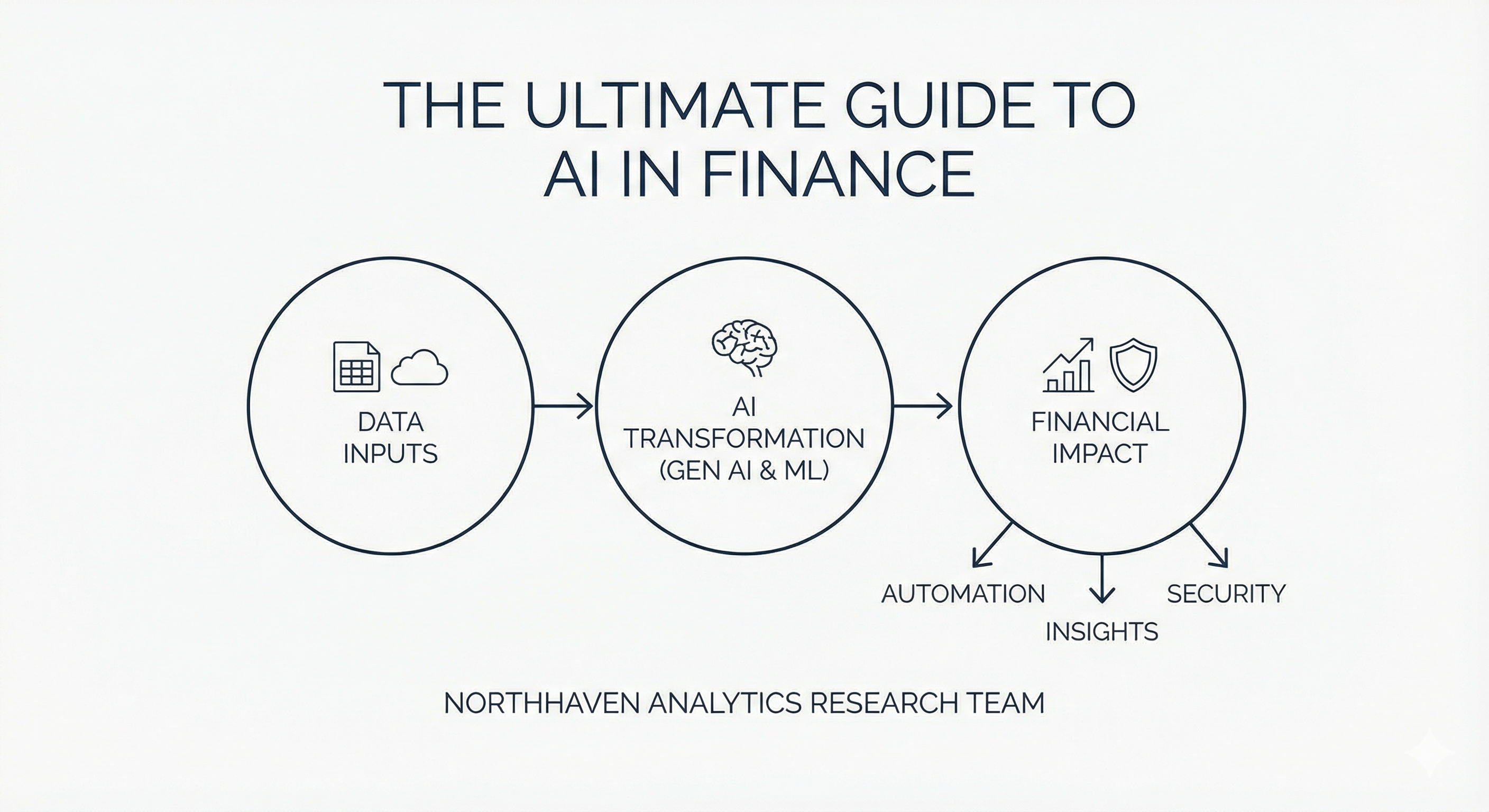
Machine Learning: How Machine Learning Works in Finance
How to build, train, and deploy machine learning models that actually work — without the data privacy risks that destroy institutional trust.

In the fiercely competitive world of institutional finance, traditional analytics have completely failed to keep pace with unprecedented global volatility. Top-tier investment banks and quantitative hedge funds must aggressively use machine learning to predict complex market shocks before they even happen — and that requires perfect training data.
What Is Machine Learning?
Machine learning is the process through which advanced computer systems learn from data and improve their performance without being explicitly programmed by human engineers. Technically, machine learning is a subset of broader artificial intelligence — a highly specialized subset that focuses entirely on creating a dynamic learning program that adapts over time as it is exposed to more information.
In practice, a learning algorithm receives vast quantities of raw, unstructured data, identifies hidden mathematical patterns, and makes autonomous, highly accurate predictions. Machine learning completely removes human emotion, fatigue, and cognitive bias from high-stakes trading and risk management.
MENT
LEARNING
"When machine learning combined with flawless synthetic data enters your institutional infrastructure, you immediately unlock unprecedented predictive power."
From Traditional to Deep Learning
The technological jump from basic traditional machine learning to modern machine learning has been nothing short of staggering. Initial evolution decades ago relied on simple, linear statistical correlations and rigid rules. Today, cutting-edge machine learning drives massive, compute-heavy deep learning models utilizing multi-layered neural networks that mimic the human brain to process non-linear financial data.
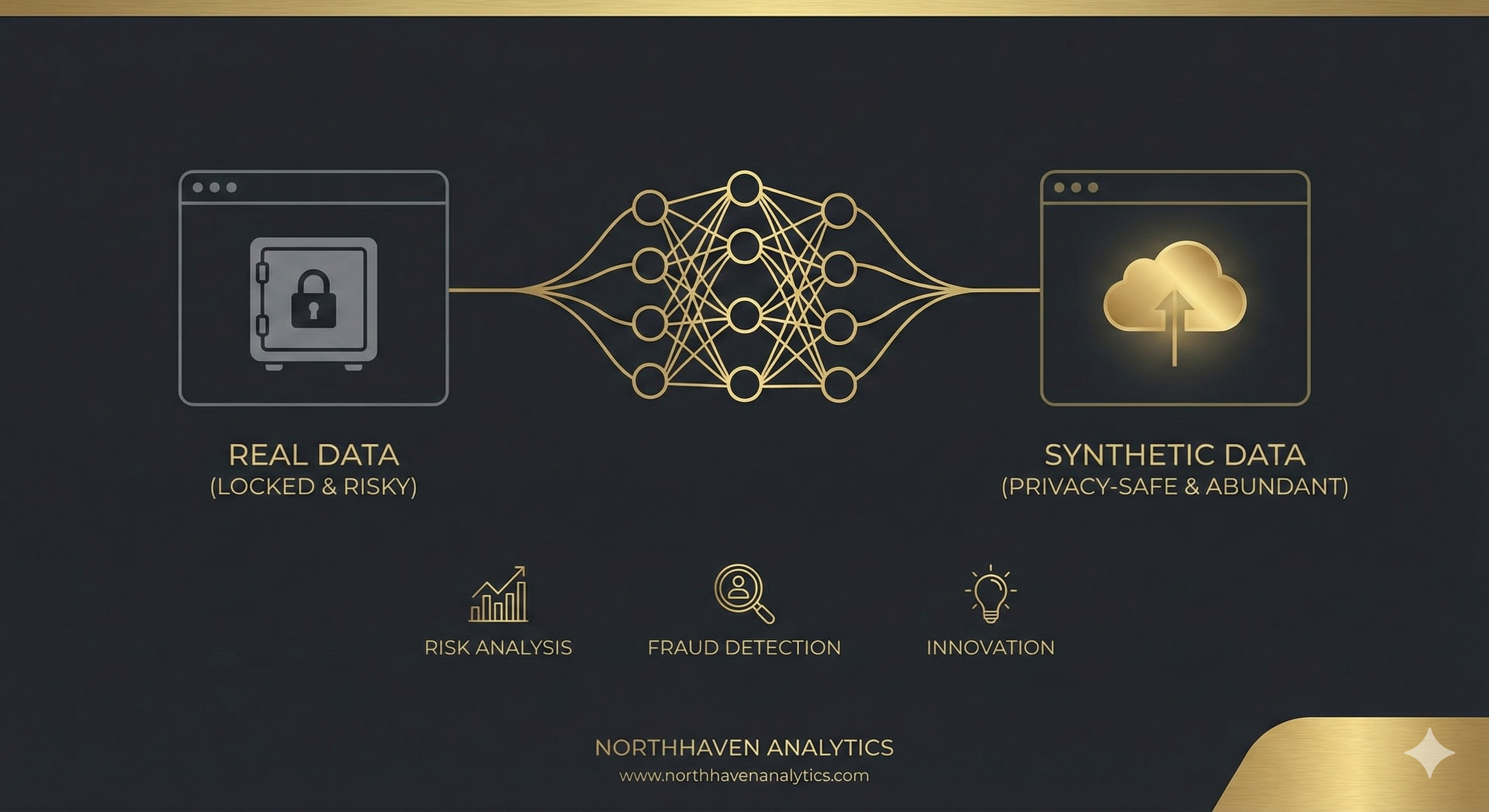
However, there is a massive catch: deep learning requires unimaginably large amounts of data to function correctly and avoid catastrophic overfitting. This data scarcity is exactly where Northhaven's synthetic data generation completely fills the void — providing the vast amounts of data inherently necessary for advanced AI systems to truly dominate financial markets.
Types of Machine Learning
To successfully deploy enterprise-grade machine learning, modern financial institutions must confidently utilize various types of machine learning. The specific methods and paradigms your quantitative teams choose depend entirely on the learning problems they are trying to solve.
The most robust and common approach in quantitative finance. It relies heavily on massive sets of labeled data where the historical answer is already perfectly known — such as a dataset of 10,000 historical mortgage defaults. Classification algorithms categorize transactions as "fraud" or "safe." Regression models forecast continuous numerical values like stock prices.
Takes a completely different approach — utilizing massive, chaotic pools of raw, unlabeled data. Deployed when you don't know exactly what you're looking for, but suspect hidden correlations exist. Machine learning can find deeply hidden clusters, invisible arbitrage opportunities, and imperceptible correlations within global supply chains that human analysts simply cannot perceive.
Trains algorithmic agents entirely through rigorous trial and error. Just like teaching an AI deep strategy through chess, a sophisticated financial learning program plays millions of synthetic market simulations. The agent receives mathematical "rewards" for profitable trades and severe "punishments" for losses — developing extraordinarily powerful institutional strategies over time.
Combines multiple weak learners into one robust predictive engine for ultimate, uncompromising accuracy. Ensemble methods like Random Forest, XGBoost, and Gradient Boosting are the workhorses of quantitative finance — combining all learning models to deliver predictions that no single algorithm could achieve alone. This approach consistently outperforms individual models across all market conditions.
Northhaven Applications
At Northhaven Analytics, we design and execute highly complex learning projects for the world's largest banks. Many machine learning teams across the globe rely entirely on our synthetic data generation to execute their most critical use cases.
When you use machine learning to analyze global transaction networks, instantaneous fraud detection becomes reality. The learning uses massive, synthetically generated datasets to recognize incredibly subtle, multi-layered anomalies — instantly catching sophisticated, state-sponsored cyber-attacks and synthetic identity fraud rings that traditional rule-based systems completely miss.
The powerful intersection of machine learning and deep learning powers highly predictive, automated portfolio rebalancing engines. Because the learning trains on millions of synthetic market shocks — simulated global trade wars, pandemics, hyper-inflationary crises — your quantitative algorithms are mathematically prepared for absolutely anything.
Eliminating Bias & Federated Learning
Machine learning's single greatest and most dangerous weakness is that it blindly learns and replicates the historical, systemic prejudices present in old, real-world banking data — such as redlining or demographic lending bias. By leveraging Northhaven's pristine synthetic data, you scrub these historical biases out of your systems completely.
As major financial institutions adopt large language models to read contracts and automate compliance, we heavily support advanced federated learning architectures — allowing massive global banks to securely train a shared machine learning program across multiple international jurisdictions without ever legally moving sensitive, regulated client data across sovereign borders.
Supported ML Libraries
Four Ways Machines Learn
Learns from perfectly labeled historical outcomes. The gold standard for fraud detection, credit scoring, and price prediction in institutional finance.
Finds hidden clusters and correlations in unlabeled data — revealing arbitrage opportunities and systemic vulnerabilities humans cannot perceive.
Trains trading agents through millions of synthetic simulations. Rewards profitable actions, punishes losses — developing elite market-beating strategies.
Combines multiple weak learners into one robust predictive engine. Consistently outperforms any single algorithm across all market conditions.
Algorithms perform best
when fed perfect data.
The fundamental law of AI remains unchanged: algorithms use what they are given. As you deploy learning techniques, remember that learning is deeply dependent on a secure, unshakeable data infrastructure. By partnering with Northhaven Analytics, you completely master the machine learning technology required to thrive in modern finance — without the severe limitations, privacy risks, and scarcity of real-world data.
Train Models That Actually Work
Stop waiting for the next data breach to reveal the flaws in your training pipeline. Let Northhaven's synthetic data infrastructure redefine your machine learning capabilities.