


Financial institutions don’t struggle because they lack data.
They struggle because they cannot use the data they already have — due to GDPR, banking secrecy, internal governance, and the impossibility of safely sharing customer-level information.
Most “synthetic data” tools solve this only partially.
They create tables that look realistic, but do not behave like true financial ecosystems.
Northhaven Analytics takes a fundamentally different approach.
Below is a detailed breakdown of how our architecture works and why it is unique in the global market.
1. Dependency-Driven Architecture: A Financial System of Interacting Layers
Real finance is a network of cause–effect relationships.
Our engine replicates this through a dependency graph that models:
- income → credit score
- credit score → overdraft limits
- overdraft limits → negative-balance probability
- negative balance → risk score
- risk score → spending volatility
This is not a correlation matrix.
It is causal logic mirroring how banks and fintech systems actually operate.
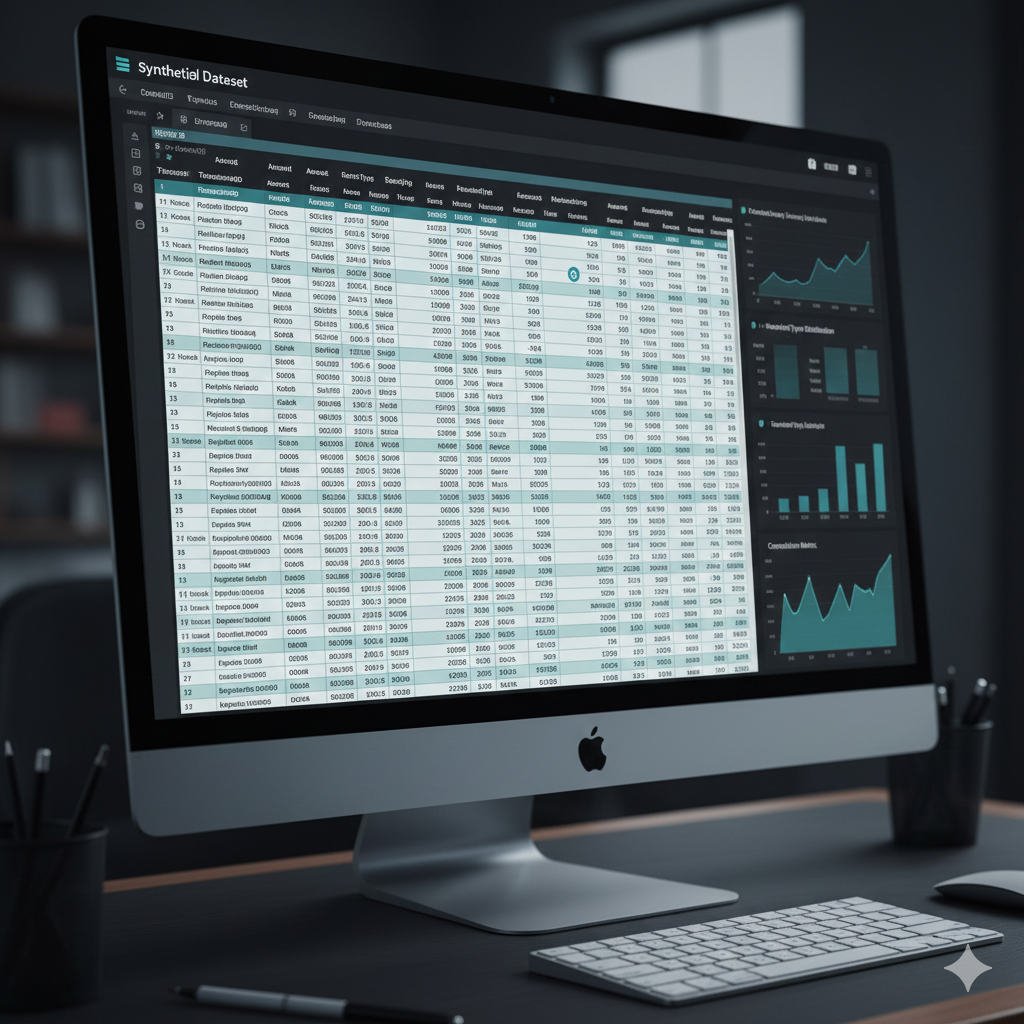
Most synthetic data generators build flat tables.
Northhaven builds financial processes.
2. Constraint-First Generation: Data Born Correct, Not Fixed Later
Traditional synthetic systems generate random values and patch errors after the fact.
Northhaven does the opposite.
Each record is generated inside a strict rule framework, for example:
- region must match country
- overdrafts must match product type
- minors cannot hold loans or adult financial products
- credit score cannot increase while income collapses (unless supported by rule-based exceptions)
- transaction patterns must match product and client segment
Because the logic is enforced during generation, data is consistent, stable, and model-ready from the first output.
3. Multi-Layer Correlation Modelling: Linear, Non-Linear & Conditional
We don’t rely on a single correlation matrix.
Northhaven uses three stacked layers:
Layer 1 — Linear correlations
income ↔ credit score
account age ↔ average balance
activity ↔ churn probability
Layer 2 — Non-linear correlations
credit score improvements diminish beyond certain thresholds
volatility grows exponentially in riskier segments
spending patterns saturate above specific income levels
Layer 3 — Conditional correlations
income ↔ spending only inside active segments
balance drift ↔ overdraft usage only if overdraft exists
seasonality ↔ volatility only for retail clients
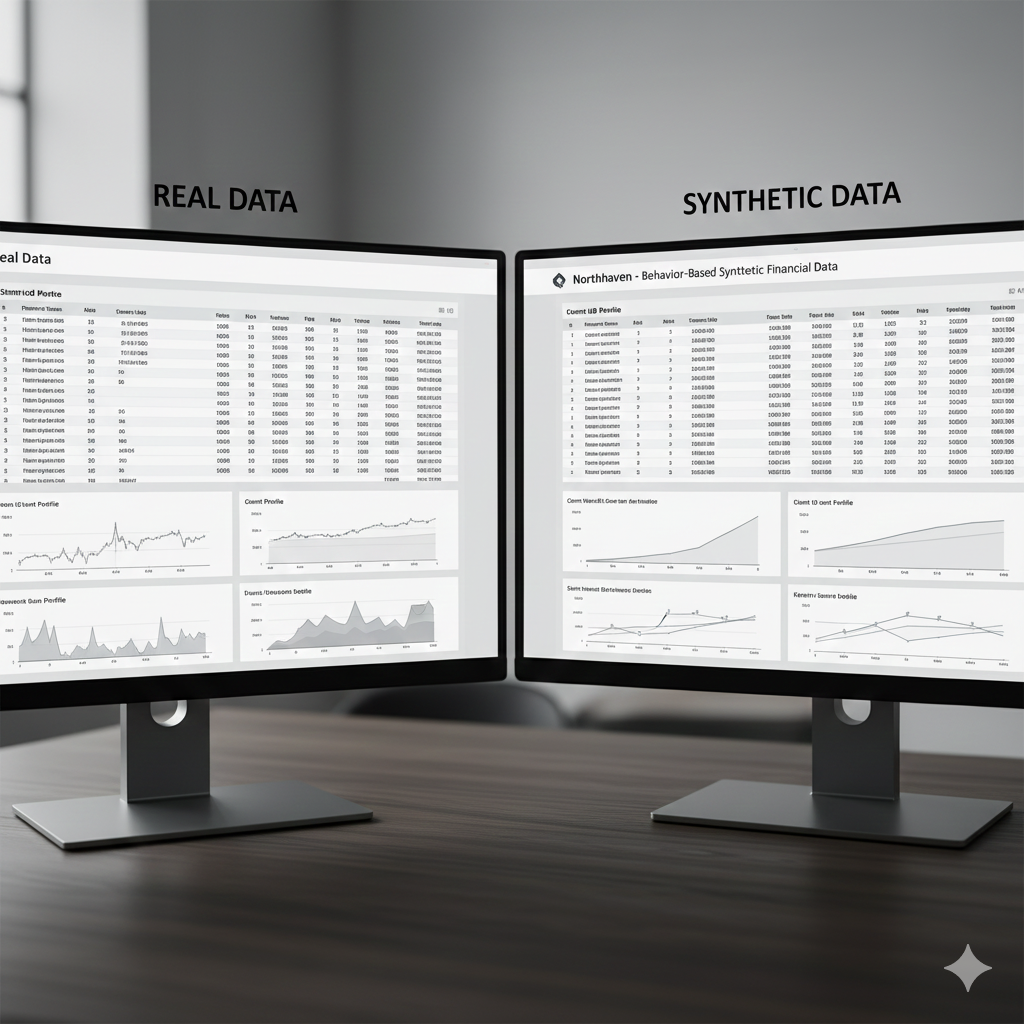
This creates dynamic, context-aware dependency patterns — identical to real banking datasets.
4. Temporal Simulation: Making Time a First-Class Variable
Financial data without temporal logic is useless.
Northhaven simulates time across multiple dimensions:
- salary cycles
- weekend and holiday spending drops
- December retail surge (+20–25%)
- volatility clusters
- activity decay and churn progression
This enables:
✓ time-series forecasting
✓ stress-testing ML pipelines
✓ realistic customer-journey modelling
✓ portfolio-level scenario simulations
Most synthetic systems generate static snapshots.
Northhaven generates behaviour evolving over time.
5. Anomaly Injection Framework: Synthetic Fraud and Rare Events
Banks don’t need only “clean” data — they need rare, dangerous, edge-case behaviour:
- fraud-like patterns
- abnormal spending spikes
- cross-border anomalies
- inconsistent client attributes
- irregular cash flow sequences
Northhaven injects anomalies in a controlled and tunable way, enabling:
✔ AML model testing
✔ fraud detection training
✔ extreme-scenario validation
✔ regulatory stress simulations
This is one of our most demanded enterprise features.

6. Continuous-Learning Loop: A Generator That Improves Itself
After each dataset is created, the engine runs a deep feedback cycle:
- recalculates correlations
- optimises distributions
- identifies weak behavioural signals
- adjusts constraints
- strengthens causal links
The longer the system runs, the more realistic it becomes.
7. Full Transparency & Reproducibility
Each dataset includes:
- metadata
- seed
- all generation rules
- correlation matrices
- validation report
- audit log
No black box.
Fully audit-ready.
Compliant by design.
Conclusion: Northhaven as the First True Digital Twin for Finance
Northhaven does not generate synthetic tables.
It reconstructs synthetic financial reality — complete with behaviour, causality, and temporal evolution.
This is not “privacy masking.”
This is next-generation financial infrastructure.