High-fidelity synthetic credit bureau reconstruction for privacy-compliant model development and acccelerated underwriting simulation.
Generate high-fidelity synthetic credit bureau data with Northhaven Analytics. Accelerate underwriting simulations and risk model development

Financial institutions rely heavily on credit bureau data. However, costs are high. Moreover, data use restrictions limit analytical depth. In addition, compliance risks are a constant burden.
Therefore, Northhaven Analytics delivers a solution. Specifically, we provide a custom Machine Learning (ML) engine. It generates statistically identical synthetic credit scoring datasets. In fact, these replicate complex behavioral sequences. Furthermore, they preserve account correlations found in real files.
Consequently, this enables banks and fintechs to train models. Specifically, they can validate granular scoring models at scale. Ultimately, this eliminates production data dependencies. And it ensures full GDPR compliance.
The Problem: Friction in Credit Risk Modeling
Credit risk teams face significant obstacles. Specifically, operational friction is high. This occurs when accessing comprehensive bureau data.
Cost Prohibitions for Granular Data
Accessing deep historical data is expensive. For instance, 60-month payment tapes cost a fortune. This applies on a per-query basis. Consequently, this prevents the use of large datasets. Therefore, robust training of deep learning models becomes impossible.
Regulatory and Compliance Restrictions
Regulatory mandates are strict. For example, GDPR limits PII usage. Therefore, sharing granular history is difficult. This is true for third-party vendors. Also, it applies internally between departments. Consequently, legal sign-offs take months. Data masking degrades utility. Ultimately, this slows model iteration.
Scarcity of Edge Cases
Modelers struggle to find specific events. For instance, consumers with thin files. Or, specific multi-loan default sequences. However, these are high-impact events. Therefore, they are crucial for refining credit loss forecasting.
Why Synthetic Data is Needed (Grounded Approach)
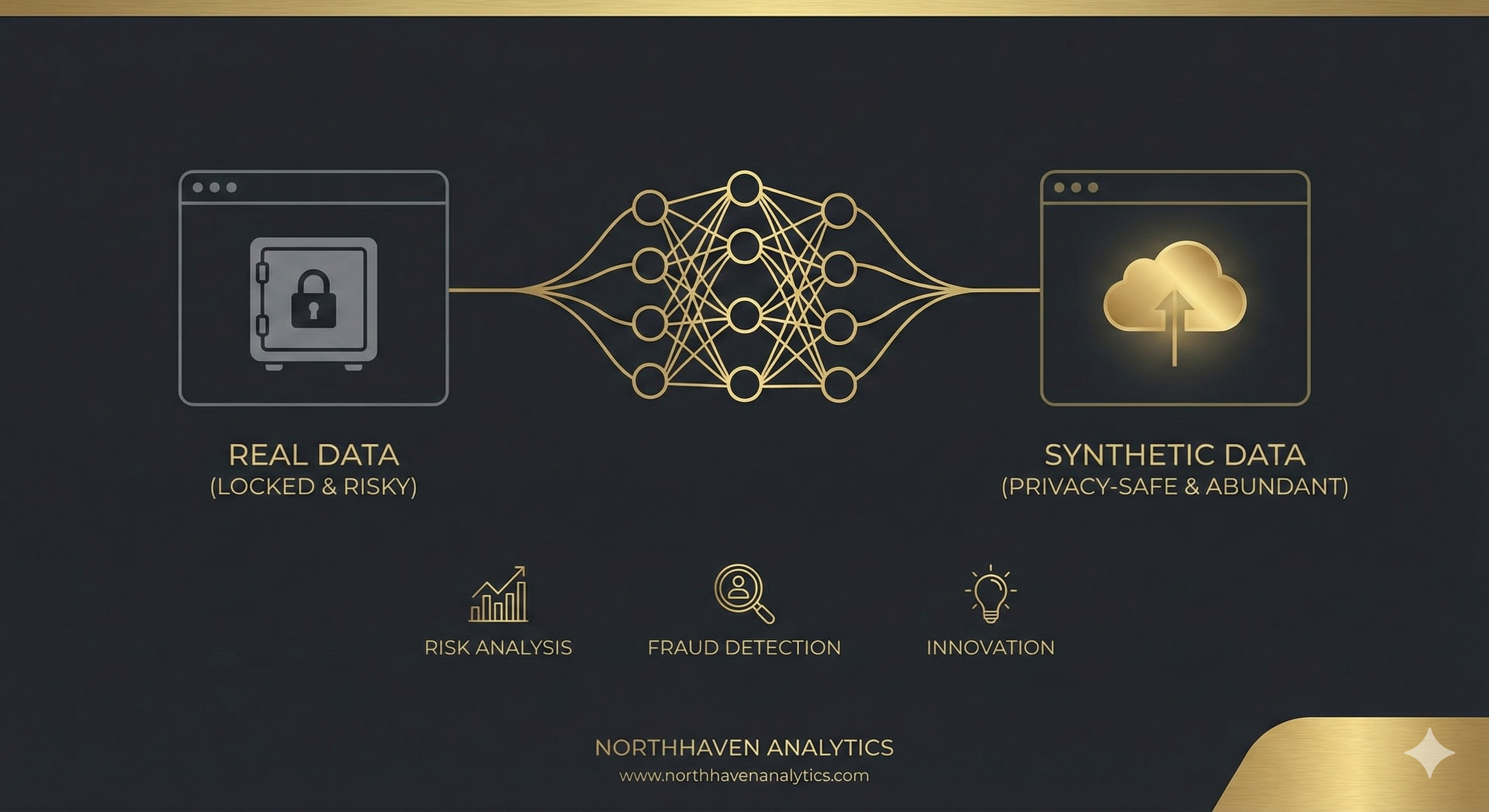
The requirement is clear. Essentially, we must decouple analytical insights from PII. Therefore, synthetic data achieves this. It trains a generative model on the statistical footprint. Consequently, it creates new, artificial records. Crucially, they remain statistically accurate.
This approach provides a safe alternative. In fact, it is legally safe and scalable. Moreover, it requires no PII transfer. Thus, researchers can perform full-history lookups. They can also run large-scale simulations. (Read about our Financial Data Simulation Tools).
Ultimately, this transforms development. It shifts from a bottleneck to a rapid workflow.
How Northhaven Solves It (Technical and Business Explanation)
Northhaven Analytics addresses this challenge by deploying a modular and auditable synthetic data engine customized to the client’s internal credit risk definitions and the structure of the Northhaven Analytics addresses this challenge. Specifically, we deploy a modular synthetic data engine. It is customized to your internal definitions.
H3: Core Generative Architecture
The engine is advanced. Specifically, it uses a CTGAN-based architecture. Moreover, it utilizes a sophisticated Discriminator. This is crucial for two reasons:
- Correlation Preservation: It excels at learning dependencies. For example, the link between credit mix and delinquency. This is essential for accurate risk scoring.
- High-Fidelity Sequences: The model learns temporal dynamics. Consequently, it synthesizes realistic month-by-month histories. (See our Synthetic Banking Datasets Engine).
H3: Modular and Scalable Deployment
The system is a Python library. Therefore, it provides enterprise-grade controls.
- Model Module: This handles training logic. Users can generate millions of histories instantly.
- Data Manager Module: This ensures consistent structuring. Specifically, fields adhere to bureau schemas. Therefore, integration is immediate.
- Git Controller Module: This provides versioning. It commits the trained model to a repository. Consequently, this ensures full auditability.
H3: Financial Logic Constraints
Northhaven embeds specific rules. For instance, underwriting and fraud rules. These acts as soft constraints. Furthermore, the continuous-learning capability helps. It allows periodic retraining. Therefore, the data does not suffer from drift. (Learn about our Data Validation and Advisory).
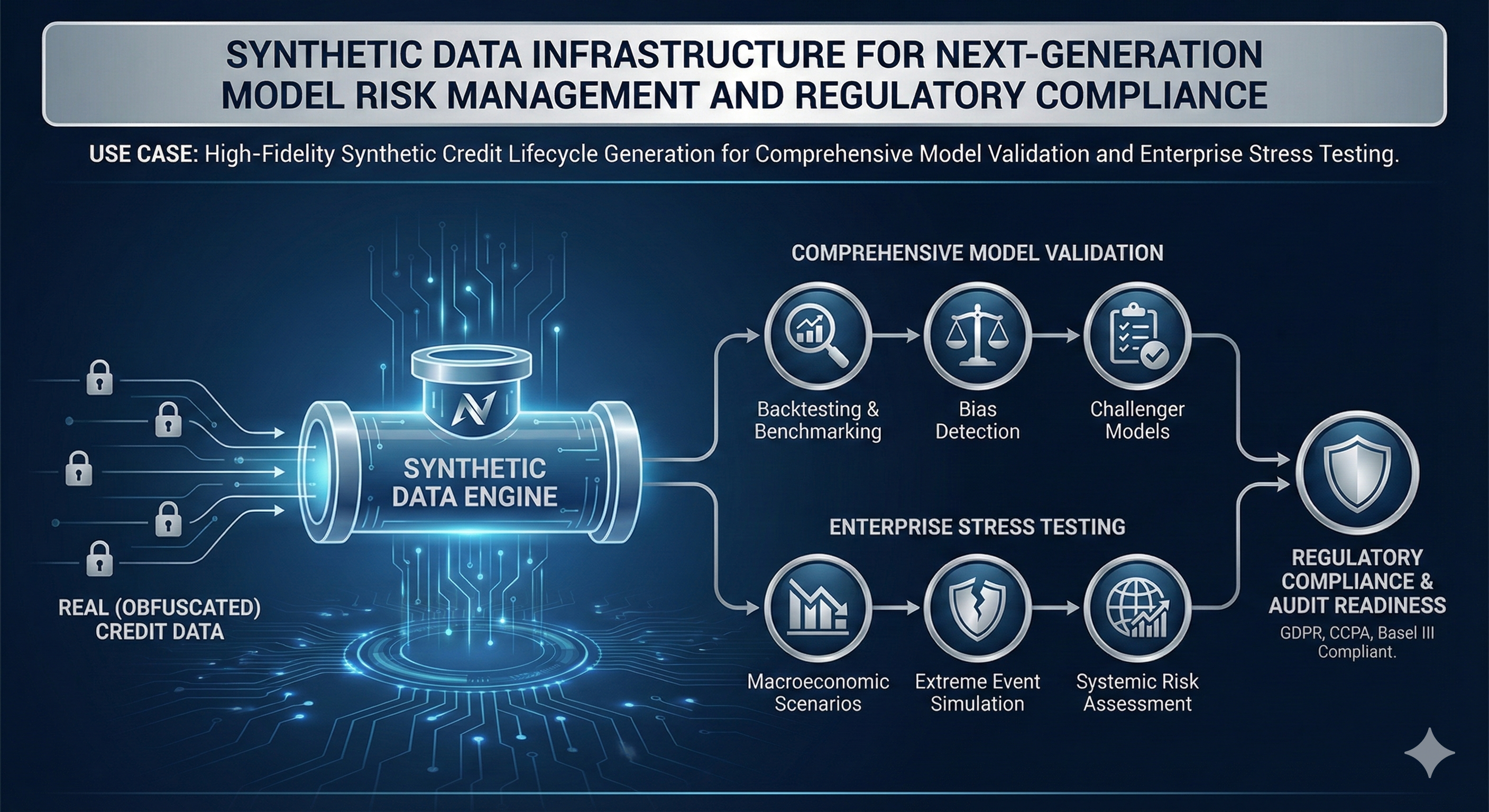
Example Synthetic Dataset Structure
The Northhaven engine is capable of reconstructing the full complexity of a consumer credit file, enabling granular model training.
| Variable Name | Description | Key Feature of Synthetic Output |
|---|---|---|
Synthetic_Consumer_ID | Unique, non-PII identifier. | Unlimited unique IDs for massive scale. |
Synthetic_Credit_Score_Range | Replicated FICO/Vantage score range distribution. | Preserves correlation with utilization and delinquency. |
Total_Credit_Limit_Aggregate | Total available credit across all synthetic accounts. | Matches real-world distribution and variance. |
Utilization_Rate_History_M12 | Monthly utilization rate for the last 12 months (time-series). | Replicates temporal dependency and volatility. |
Payment_Status_M60 | Full 60-month payment history (Current, 30 DPD, 60 DPD, Default). | Preserves realistic transition probabilities (Markov Chain). |
Credit_Mix_Correlation | Correlation between loan types (e.g., mortgage, auto, revolving credit). | Preserved as a multivariate distribution by the CTGAN engine. |
Rare_Event_Flag_30_DPD | Flag identifying specific delinquency sequences. | Over-samples rare sequences for model robustness. |
Results (Measurable Improvements)
The implementation of the Northhaven synthetic credit bureau solution delivers quantifiable benefits across governance and operations.
| Metric | Improvement | Description |
|---|---|---|
| Bureau Query Cost Reduction | ~95% Reduction | Drastically reduces the dependency on expensive per-query historical credit bureau lookups for model training. |
| Model Iteration Speed | 4x Faster | Accelerates the feature engineering and model training cycle from weeks to days due to instant data provisioning. |
| Correlation Fidelity | > 0.95 (Target) | Achieves a Pearson correlation coefficient greater than 0.95 between synthetic and real data for critical feature pairs. |
| Delinquency Event Coverage | 100% Guaranteed | Ensures sufficient synthetic data points are generated for all specified low-occurrence default and delinquency sequences. |
| Compliance Risk | Near Zero PII Risk | Eliminates the privacy exposure associated with handling or sharing real credit histories, simplifying GDPR compliance. |
Why Northhaven is Uniquely Suited for this Use Case
Northhaven Analytics is uniquely positioned to solve the credit bureau data challenge due to its focused, engineering-first approach and specialized ML architecture:
Domain-Specific Generative Modeling: Unlike general-purpose synthetic platforms, Northhaven’s engine is specifically optimized for financial time-series and tabular data, employing CTGAN derivatives and Discriminators proven to maintain high fidelity in complex correlation structures unique to credit risk.
ML-as-a-Library Integration: The system’s delivery as a modular Python library allows quantitative research and risk teams to integrate the generator directly into their existing Python/Jupyter workflows. The ability to generate or train models in just two lines of code significantly lowers the barrier to entry for full-scale synthetic data use.
Auditable Versioning: The built-in git_controller ensures that every synthetic dataset generated can be traced back to the exact version of the generative model and the statistical metadata used, providing an essential component for regulatory auditability and Model Governance.
Custom Constraints and Continuous Learning: The ability to rapidly adapt the model to new variables and embed client-specific financial logic ensures the synthetic credit history is not just statistically similar, but behaviorally and structurally correct according to the institution’s own underwriting policies.