The Evolution of Fintech Infrastructure: How Financial Technologies and AI Are Reshaping the Global Fintech Ecosystem and Financial Institutions
Explore how Northhaven Analytics powers the fintech ecosystem. From financial technologies and blockchain to payment solutions and AI
In the expansive and rapidly shifting world of financial services, a quiet but powerful revolution is underway. It is driven by fintech—short for financial technologies—a dynamic force that has fundamentally reshaped how financial institutions, banks and fintechs, and everyday consumers interact with money. The fintech industry is no longer just a loose collection of a few ambitious fintech start-ups trying to disrupt traditional financial models with a mobile app. It has matured into a complex, interconnected fintech ecosystem where vast amounts of financial data, sophisticated automation, and advanced machine learning converge to create new financial realities and opportunities.
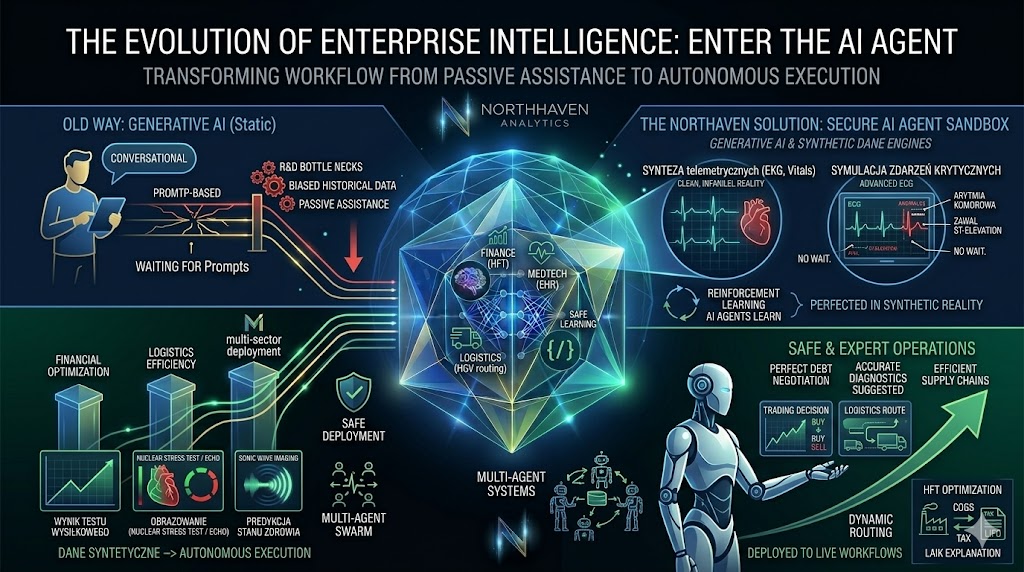
Northhaven Analytics stands at the critical center of this transformation. We do not just observe the growth and innovation occurring in the market; we provide the deep-tech infrastructure that allows fintech firms, agile technology companies, and massive traditional banking giants to deploy fintech products safely and efficiently. From instant payment solutions to decentralized blockchain technology, our synthetic data engines enable the development of fintech at a scale and speed previously impossible, ensuring that the financial system remains robust against shocks.
Defining Fintech in 2026: A Deep Dive into Financial Technologies, Digital Payment Apps, and the Modern Fintech Sector
To truly understand the trajectory of the sector, we must first comprehensively define what is fintech. Broadly speaking, fintech refers to the application of technology—software, algorithms, and connectivity—to improve, streamline, and automate the delivery and use of financial services. This includes everything from consumer-facing mobile payment apps like PayPal and Venmo to complex, back-end B2B financial operations software that powers global trade.
The fintech sector has expanded rapidly in the last decade because fintech helps bridge the widening gap between legacy traditional financial services and the modern consumer’s insatiable need for speed, transparency, and convenience. New technologies such as artificial intelligence (AI), machine learning in fintech, cloud computing, and distributed ledger technology are the engines behind this change, enabling financial transactions to happen in milliseconds rather than days.
However, as fintechs scale globally, they face a critical hurdle: the sanctity of financial data privacy. Whether it is a unicorn startup building a new crypto exchange or a major financial system player integrating open banking APIs, the need for secure, high-fidelity testing data is paramount. This is where Northhaven’s automation and cybersecurity protocols come into play, offering a safe harbor for innovation.
The Complex Fintech Ecosystem: How Banks and Fintechs Collaborate to Deliver Innovative Financial Products and Services via APIs

The relationship between banks and financial startups has evolved significantly from adversarial competition to strategic collaboration. Many fintech companies now provide the innovative solutions that traditional banking relies on to serve tech-savvy customers. This fintech ecosystem relies heavily on APIs (Application Programming Interfaces) to centralize fintech companies and connect disparate systems, creating a seamless web of financial information.
How Fintech Helps Businesses and Financial Institutions Optimize Operations
Fintech helps businesses of all sizes streamline their financial management, optimize payment processing, and enhance transaction monitoring. Modern fintech solutions allow companies to transfer money globally across borders in seconds, bypassing the slow correspondent banking networks of the past. But to trust these high-speed systems, financial institutions must stress-test them rigorously.
Northhaven allows fintech firms to simulate millions of compliant financial transactions. Before a digital payment platform goes live to the public, our AI generates synthetic scenarios—ranging from a sudden spike in transaction volume during Black Friday to complex, multi-vector fraud attempts. This ensures that fintech apps and banking services remain robust, compliant, and always online.
Exploring the Types of Fintech Transforming the Market: Blockchain Technology, Cryptocurrency, Wealthtech, and Payment Solutions
The types of fintech are vast and growing, covering every aspect of the financial industry. Fintech innovation is visible in several key pillars:
- Payment Solutions and Digital Banking: The rise of fintech banks (often called neobanks) and peer-to-peer payment apps has revolutionized how we access to financial funds. These products and services prioritize user experience (UX) and low fees, forcing traditional financial services to adapt or die.
- Blockchain and Cryptocurrency: Utilizing blockchain and crypto assets to decentralize the financial system. This includes everything from Bitcoin to stablecoins and Central Bank Digital Currencies (CBDCs).
- Wealthtech and Trading: Apps like Robinhood or eToro that allow users to buy and sell stocks, ETFs, and commodities with zero commission. This also includes “Robo-advisors” that provide automated financial advice based on algorithms rather than human intuition.
- Insurtech: The application of fintech in insurance (as discussed in our coverage of the insurance company sector), using IOT and telematics to price risk dynamically.
- RegTech (Regulatory Technology): Utilizing automation to help financial services companies comply with regulations like AML (Anti-Money Laundering) and KYC (Know Your Customer) efficiently.
Blockchain, Crypto, and Non-Fungible Tokens (NFTs) in the B2B Space
The rise of cryptocurrency and non-fungible tokens (NFTs) has introduced new complexity to the market. Fintech companies like those in the crypto space require robust cybersecurity measures to prevent wallet hacks and smart contract exploits. Northhaven simulates distributed ledger technology failures and 51% attacks to help fintechs prepare for the worst. We model the volatility of new financial technologies so that financial services companies can regulate their exposure to digital assets without stifling innovation.
Machine Learning in Fintech: Leveraging Artificial Intelligence and Automation to Secure Financial Data and Optimize Transactions

Machine learning and artificial intelligence are not just buzzwords; they are the backbone of modern fintech applications. Machine learning in fintech is the brain that processes the massive lakes of data generated by users. It is used for:
- Fraud Detection: Analyzing patterns in financial information to spot anomalies and stop fraudulent financial transactions in real-time.
- Credit Scoring: Helping the underserved access capital by analyzing alternative data points (e.g., utility payments, rent history) rather than just FICO scores.
- Personalization: Tailoring financial products and services to individual needs, predicting when a user might need a loan or an insurance policy.
- Algorithmic Trading: Using AI to execute trades at speeds humans cannot match, adding liquidity to the markets.
Northhaven’s core offering empowers this automation. We create synthetic datasets that train machine learning models for fintech start-ups and traditional financial incumbents. This allows for the development of fintech algorithms that are unbiased, highly accurate, and compliant with privacy laws, without ever exposing real customer PII (Personally Identifiable Information).
Northhaven Use Cases: Enabling Fintech Firms and Technology Companies to Launch Secure Fintech Offerings and Financial Solutions
We see numerous fintech use cases where our infrastructure makes the difference between a successful launch and a regulatory fine or a security breach.
1. Accelerating Payment Processing for B2B Fintechs
B2B fintechs often deal with sensitive corporate data and trade secrets. When building payment solutions or supply chain finance platforms, they need to test APIs against massive, realistic datasets. Northhaven provides synthetic financial data that mimics the complexity of global financial operations—including multi-currency settlements and invoice factoring logic. This allows fintech innovation to proceed without GDPR or CCPA risks.
2. Financial Inclusion for the Underserved
Fintech has helped expand access to financial services to the underserved populations who are “credit invisible.” Traditional financial institutions often lack data on these groups. Fintech apps use alternative data to build credit profiles. Northhaven synthesizes these profiles, creating diverse cohorts of virtual customers. This allows fintech firms to model risk for unbanked populations effectively, designing products and services that are both inclusive and profitable.
3. Cybersecurity in Digital Payment and Banking Services
Security is the #1 concern in the financial services industry. Cybersecurity threats evolve daily, with hackers using AI to breach systems. Fintech solutions must be resilient. We allow technology companies to simulate cyber-attacks on their digital banking infrastructure, ensuring that financial data remains secure during every transaction. By stress-testing the system against synthetic threats, fintechs can patch vulnerabilities before they are exploited.
The Future of the Financial Services Industry: Growth and Innovation in Fintech Applications, Super Apps, and the Global Financial System (2026 and Beyond)
The fintech industry is projected to continue its massive growth and innovation. We will see more fintech applications that centralize fintech companies into “Super Apps”—platforms where a user can message friends, order food, transfer money, buy and sell stocks, and take out a loan, all in one place. The line between fintech banks and traditional financial entities will blur completely as “Embedded Finance” takes over—where every company becomes a fintech company.
Fintech also plays a vital role in regulatory compliance (RegTech). As governments move to regulate cryptocurrency, digital assets, and complex fintech offerings, the demand for audit-ready data increases. Fintech has expanded into every corner of the economy, and fintech products are now essential to daily life, from the coffee shop POS to the backend of the stock exchange.
Benefits of Fintech and Northhaven’s Role in the Revolution
The benefits of fintech are clear: unprecedented speed, significant cost reduction, and democratic accessibility. However, sustainable fintech innovation requires a solid foundation. Fintechs need a sandbox that is safer than the real world but just as complex to test their theories.
Whether you are a scrappy startup building the next PayPal, a tier-1 bank integrating blockchain technology for cross-border settlement, or a firm offering financial advice via generative AI, Northhaven provides the infrastructure you need. We help you transfer money securely, manage financial information privately, and disrupt traditional financial roadblocks effectively.
Fintech companies like yours cannot afford to wait for data. You need products and services that are tested, validated, and ready for the financial sector of tomorrow. With Northhaven, you build the future on a foundation of certainty.