

By Northhaven Analytics Research Team
Introduction: Solving the Scarcity Crisis with Synthetic Data
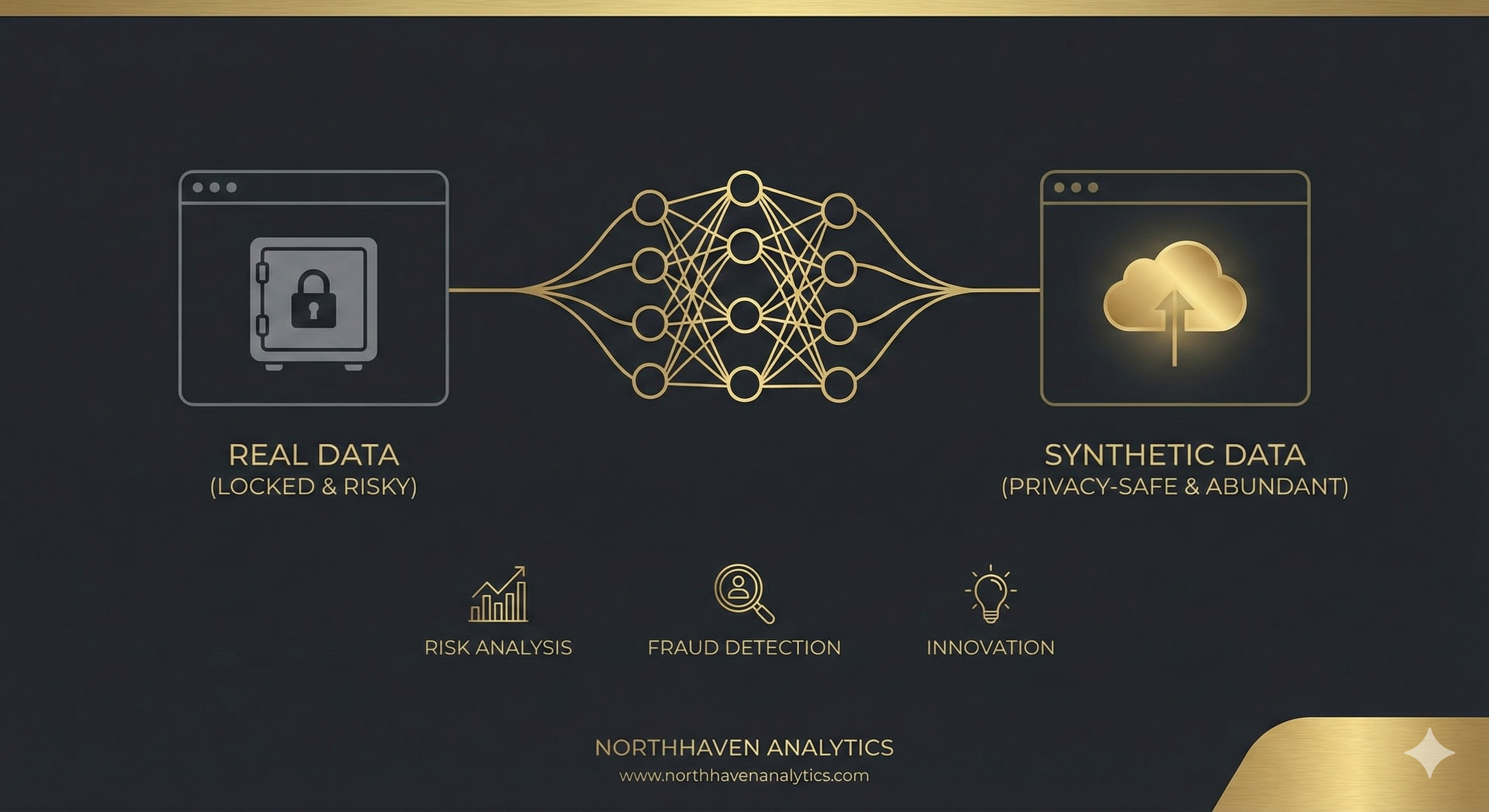
In the modern digital economy, data is the new oil, but for the financial institution, it is often treated like toxic waste. While banks possess petabytes of real financial data, using it to build AI models is fraught with regulatory peril and technical friction. This creates a paradox: data is scarce in terms of utility, despite being abundant in volume.
The solution lies in synthetic financial data.
By leveraging generative AI, organizations can generate synthetic data that mirrors the statistical properties of real world information without exposing sensitive details. This guide explores how synthetic data generation is revolutionizing risk analysis, fraud detection, and the entire financial innovation landscape. We will explore how synthetic assets are created, the technical challenges involved, and why synthetic data is superior to traditional anonymization.
What is Synthetic Financial Data?
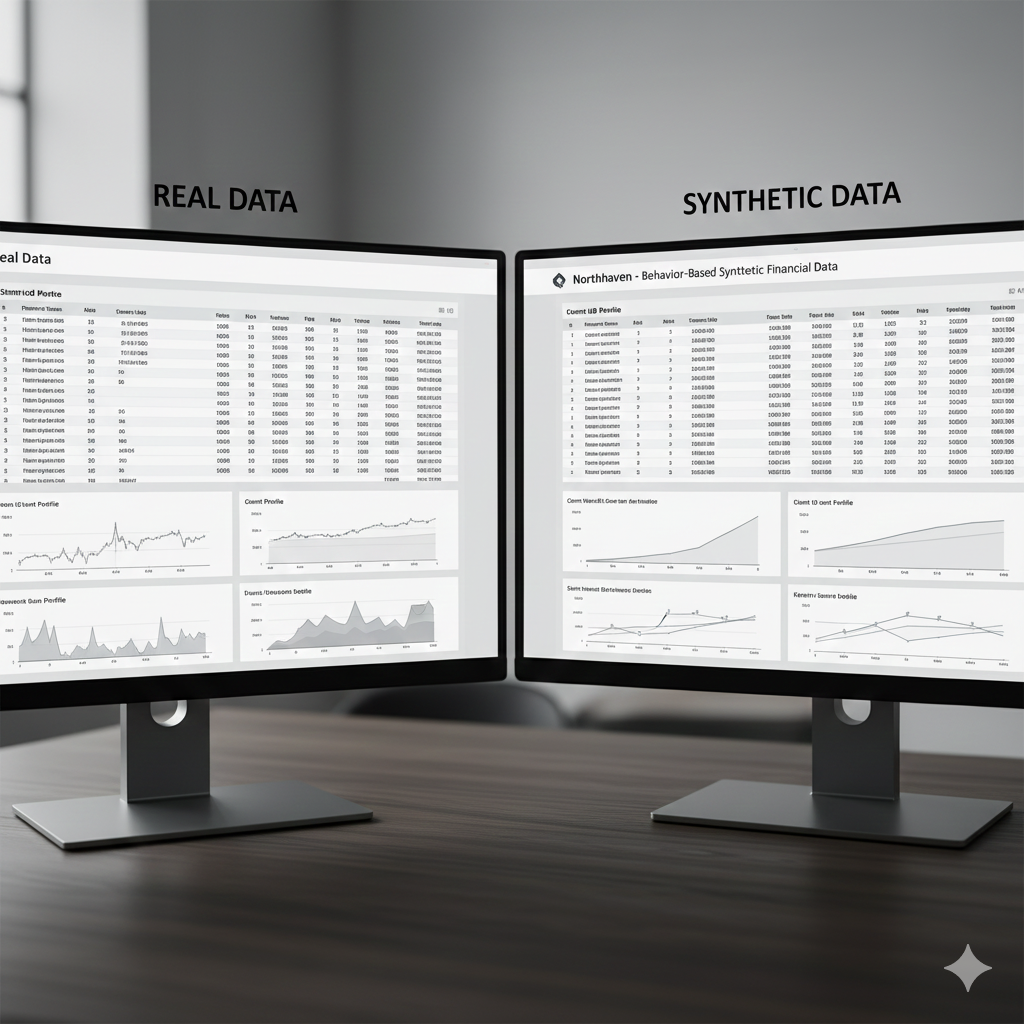
Synthetic financial data is artificially generated information that retains the statistical patterns and correlations of a real dataset but does not contain any real customer PII (Personally Identifiable Information).
It is not just random noise. High-quality synthetic data is engineered to look and behave like real financial records. A synthetic dataset might include tabular rows representing loan applications, time series vectors representing historical prices, or multi-table relational structures representing complex transaction types.
The data generated by Northhaven Analytics creates a „Digital Twin” of your portfolio. This data offers a mathematical guarantee of privacy while preserving the properties of real financial behavior, allowing data scientists to use synthetic data for critical financial applications.
The Technology: How We Generate Synthetic Data
The generation process is driven by advanced machine learning architectures. To generate synthetic assets that are indistinguishable from reality, we utilize two primary frameworks:
1. Generative Adversarial Networks (GANs)
Generative adversarial networks consist of two neural networks pitted against each other in an adversarial game. One network (the Generator) attempts to create synthetic records, while the other (the Discriminator) tries to distinguish them from real data. This workflow forces the model to learn the exact distribution of the original data.
2. Variational Autoencoders (VAEs)
Variational autoencoders compress input data into a lower-dimensional latent space and then reconstruct it. This allows us to capture conditional distributions and generate new data points that fit the learned manifold.
At Northhaven, our data generator uses a hybrid approach to ensure high-fidelity synthetic data. Our AI-powered engine ensures that the generated data captures complex data structures, including volatility clusters in market feeds and non-linear correlations in credit scoring.
Why Financial Institutions Need Synthetic Datasets

The nature of financial analytics is changing. Fintech startups and incumbent banks face the same hurdles: privacy concerns and the need for massive datasets to train AI.
Overcoming Data Scarcity and Bias
Often, real financial data regarding specific scenarios (like a market crash or a specific fraud vector) is limited. Synthetic data helps overcome this scarcity. We can generate realistic synthetic samples of rare events, creating synthetic financial datasets that are balanced and robust. This data generation capability is essential for training AI models that generalize well.
Enabling Advanced Fraud Detection
Fraud detection relies on identifying anomalies. However, real fraud is rare. By using synthetic data in finance, we can simulate millions of adversarial fraud scenarios. This high-quality data allows machine learning algorithms to learn the „shape” of fraud more effectively than they could from historical data alone.
Privacy, Compliance, and Data Protection
The defining advantage of synthetic data is its privacy-safe nature. Traditional anonymization techniques (masking, hashing) destroy data utility and fail to protect against re-identification attacks.
Synthetic data eliminates this risk. Because the data contains no real individuals, it falls outside the scope of privacy regulations like GDPR and CCPA.
Navigating GDPR and CCPA
GDPR and CCPA impose strict limits on data usage. However, artificially generated information is not personal data. This means synthetic data across borders can be shared freely. It allows for protecting privacy while unlocking data utilization. This data preserves the statistical integrity required for decision-making without the legal liability of handling real data.
The Workflow: From Real Data to Synthetic Reality

To produce synthetic data, Northhaven follows a rigorous pipeline:
- Ingestion: We analyze the real financial source.
- Learning: Our generative models learn the statistical properties and probability distributions.
- Synthesis: We generate synthetic data at scale (e.g., 1 billion rows).
- Validation: We compare the synthetic datasets against the real ones to ensure high-quality synthetic fidelity.
This workflow results in a synthetic data set that supports visualization, risk modeling, and customer experience optimization.
Technical Challenges in Generating Realistic Financial Data
Creating data that looks and acts like the real thing is difficult. High-dimensional data often suffers from mode collapse. Furthermore, financial data is inherently multi-table and temporal.
Northhaven’s architecture solves this by using time series modeling (TSM). To ensure temporal causality (e.g., a transaction history that makes sense over time). We also ensure that conditional distributions are maintained—for example, ensuring that high-income synthetic customers have appropriate credit limits. This attention to detail results in high-fidelity synthetic data that is statistically valid for risk analysis.
The Future: AI and Synthetic Data
As language model capabilities and generative AI evolve, the role of synthetic data generation will only grow. It is the bedrock of new solutions in fintech.
Whether you need market data for backtesting, financial datasets for academic research, or a privacy-safe sandbox for third-party developers, synthetic financial infrastructure is the key.
Synthetic data is not just a workaround; it is an upgrade. It allows you to simulate the future, generate realistic scenarios, and deploy AI with confidence.
