Data Leakage Prevention: The Definitive Guide to Preventing Leaks
In the hyper-connected digital economy, an organization's data is its most valuable asset. Data leaks happen every day — often not due to sophisticated hackers, but due to internal negligence, inadequate security policies, or malicious insiders. Data leakage prevention has moved from an IT checklist item to a critical boardroom imperative.

This comprehensive guide covers DLP tools, the root causes of data leaks, governance strategies, regulatory compliance requirements, and how synthetic data represents the ultimate prevention paradigm — eliminating the target itself.
internal actors
of a data breach
DLP must protect
4% global revenue
What is Data Leakage? Leak vs. Breach — Understanding the Difference
Data leakage refers to the unauthorized transmission of data from within an organization to an external destination. A data leak is often silent — data leaves the corporate perimeter without triggering traditional intrusion alarms because the user may have legitimate access to the system.
Understanding the distinction between a leak and a breach is critical for building the right defenses. Both result in exposed sensitive data — but the attack surface and prevention strategy differ fundamentally.
Typically involves a hostile intrusion — an attacker forces entry to steal data. Intrusion prevention systems and perimeter defenses are the primary countermeasure. The threat originates outside the organization.
Often involves accidental exposure or an insider threat — someone with legitimate access transmits confidential data to the wrong place. DLP tools are the primary countermeasure. The threat originates inside the organization.
Key insight: A data loss prevention solution must address both accidental loss and malicious exfiltration. Perimeter defense alone is insufficient — data leakage detection must be integrated into the broader security framework as an internal control layer.
Common Causes of Data Leaks: How Data Leaves the Organization
To effectively prevent data leakage, security teams must understand its root causes. The vast majority of incidents fall into three categories — each requiring a different prevention approach.
The most frequent culprit. An employee sends an email containing critical data to the wrong recipient, or sensitive data is uploaded to a public cloud bucket due to misconfiguration. Accidental leaks are often the result of poor training or overly complex workflows — not malicious intent.
A disgruntled employee or contractor decides to intentionally leak data for personal gain, revenge, or corporate espionage. They use USB drives, personal email, or cloud storage to facilitate exfiltration — bypassing standard controls because they have authorized access to the system.
Data movement via instant messaging, unencrypted email, or file-sharing services creates major vulnerabilities. Data in transit is highly susceptible to interception if not encrypted. Transmission of sensitive data over unsecured networks is one of the most exploited vectors.
What is Data Loss Prevention (DLP)? The Three States of Data
Data loss prevention is a set of tools and processes used to ensure that sensitive data is not lost, misused, or accessed by unauthorized users. DLP software classifies regulated, confidential, and business-critical data — and identifies violations of policies defined by the organization.
Effective DLP policies must protect data in three distinct states. Each state presents unique vulnerabilities and requires dedicated technical controls.
Data stored in databases, file servers, and cloud storage. DLP tools scan storage repositories to detect exposed credit card numbers, PII, or financial records that should be restricted or encrypted.
Data transferring across the network. Prevention systems monitor email traffic, web uploads, and API calls to prevent sensitive data from crossing the network boundary to unauthorized destinations.
Data currently being processed by endpoints — laptops, desktops, mobile devices. DLP software monitors clipboard activity, screenshots, and printing to prevent unauthorized access at the point of use.
What Modern DLP Tools Offer
Analyzing the content of files and communications to detect social security numbers, PCI data, personal identifiers, or proprietary intellectual property — before transmission occurs.
Understanding the full context of a data transfer — who is sending, where data is going, at what time, from which device — to distinguish legitimate operations from suspicious activity.
Automatically stopping unauthorized data transfers in real time — before sensitive data leaves the organization. Alerts are sent to security teams for review and incident response.
Strategies for Data Leakage Prevention and Governance
Implementing a comprehensive data leak prevention strategy requires more than software. It requires a holistic approach to data governance, culture, and continuous monitoring — built on four foundational pillars.
The first step in data security is understanding what you have. You cannot protect what you cannot see. Data classification involves tagging data based on sensitivity levels — Public, Internal, Confidential, Restricted. Security teams must identify different types of data across the entire enterprise.
Access control ensures that employees access only the data necessary for their specific role. This minimizes the blast radius of any insider threat or compromised account. Strong multi-factor authentication prevents unauthorized data access even when credentials are stolen.
Security teams must monitor data activity continuously. DLP tools should alert immediately when suspicious transfer patterns occur — such as a bulk download of financial records at 2 AM. Data flow analysis helps identify anomalies before they become incidents.
Encrypt data at rest and in transit. Even if a data leak occurs, encryption ensures the data remains unreadable to unauthorized parties. This is the last line of defense — if exfiltration succeeds, the data is still useless without the decryption key.
Data Leakage Prevention Best Practices
Building a resilient prevention system requires disciplined implementation across people, process, and technology. These are the practices that separate mature security programs from reactive ones.
Establish strict, written rules regarding data handling. Every employee must understand the consequences of sending confidential data to the wrong person or uploading it to an unauthorized service.
Educate staff on data security continuously — not just at onboarding. Teach how accidental data exposure happens, how to recognize phishing, and how to handle sensitive data correctly. The human element is the most critical control.
Securing laptops, mobile devices, and removable media is critical. A lost or stolen laptop without full-disk encryption is an immediate data breach. Enforce device management policies and remote wipe capabilities across the fleet.
Ensure third-party vendors adhere to your data protection standards. Supply chain exposure is a major — and often overlooked — vector for data leakage. Contractual DPA obligations and periodic vendor audits are non-negotiable.
Conduct regular data security audits to verify that DLP policies are enforced correctly. Penetration testing simulates insider threat scenarios to identify gaps before real attackers do.
Have a documented, tested incident response plan specifically for data leakage events. Time-to-containment is the critical metric — every hour of undetected exfiltration multiplies regulatory and reputational exposure.
GDPR, PCI DSS, and CCPA: The Legal Dimension of Data Leakage
Data protection is not just a security issue — it is a legal and fiduciary obligation. Privacy regulations mandate strict data leak protection, and the consequences of non-compliance can be existential for a business.
A robust data loss prevention solution helps demonstrate compliance by logging all data access and data movement with full audit trails. For PCI DSS specifically, DLP tools are required to ensure that PANs (Primary Account Numbers) are never stored or transmitted in violation of cardholder data security standards.
GDPR mandates that any leakage of personal data must be reported to the supervisory authority within 72 hours. Organizations without continuous DLP monitoring cannot meet this obligation.
The Ultimate Prevention: Eliminate the Target with Synthetic Data
All prevention strategies discussed so far share a common assumption: that sensitive data must exist in testing, analytics, and AI training environments. Northhaven Analytics challenges that assumption entirely.
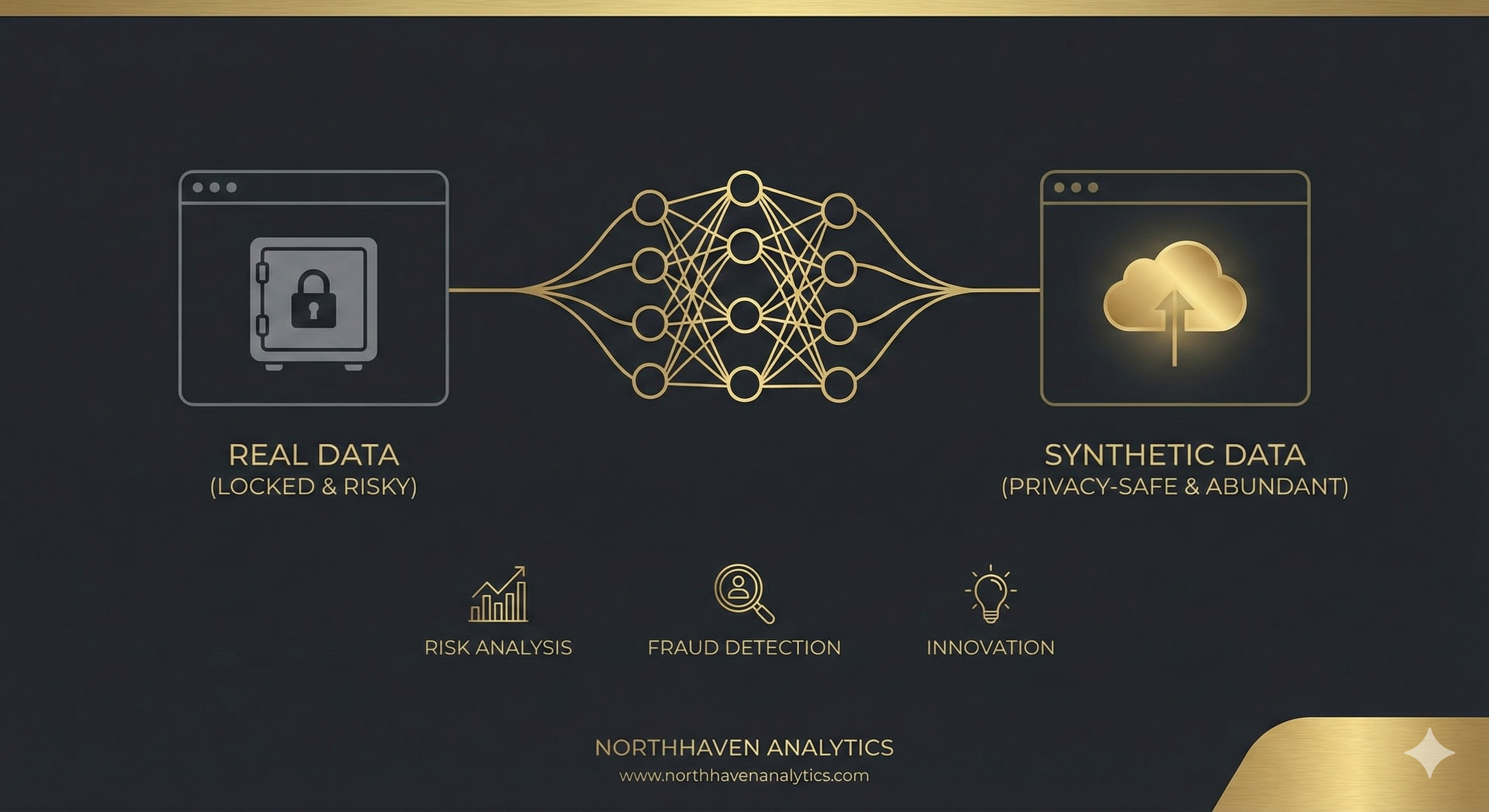
The most effective way to prevent data leakage is to avoid using sensitive data whenever possible. By generating synthetic data that mirrors the statistical properties of real-world datasets — but contains no identifiable information — Northhaven enables organizations to operate AI development pipelines at full fidelity without the risk.
Even if a leak occurs in a synthetic data environment, no confidential information is exposed. The data is artificial. There is no regulatory obligation, no customer impact, and no reputational damage. This is data leakage prevention at its most fundamental level.
Synthetic data generated by Northhaven contains no PII, no real account numbers, no identifiable records. It is GDPR and HIPAA compliant by design — not by policy. Compliance is structural, not procedural, eliminating an entire class of regulatory risk.
Northhaven's synthetic datasets preserve statistical distributions, correlations, and behavioral patterns of the original data. AI models trained on synthetic data perform at 90–95% of real-data accuracy — with zero leakage risk.
Without DLP review processes, access control gates, and legal approval chains on every data request, development and testing cycles accelerate dramatically. Synthetic data eliminates governance friction without sacrificing data integrity.
The Northhaven principle: Traditional DLP builds walls around sensitive data. Synthetic data removes the need for those walls in non-production environments. One approach protects the data. The other eliminates the risk by design. Both are necessary — and together, they represent the most complete data leakage prevention architecture available.
Securing the Organization's Data Assets: A Complete Framework
Data security is an ongoing discipline. Data leaks happen — but their impact can be minimized, and in many environments, the risk can be eliminated entirely with the right prevention architecture.
Know what data you have, where it lives, and who has access. Data classification is the foundation of every effective DLP program — you cannot protect what you cannot see.
Deploy data loss prevention software that covers all three states — at rest, in motion, in use. Continuous monitoring and real-time alerting are non-negotiable for a mature security posture.
GDPR, PCI DSS, and CCPA are not optional. A DLP solution with full audit logging is the operational requirement for demonstrating compliance in any regulated environment.
For AI training, testing, and analytics, eliminate sensitive data from the pipeline entirely. Northhaven Analytics synthetic data provides full statistical fidelity with zero leakage risk — compliance by design.
Northhaven Analytics
Eliminate data leakage risk in non-production environments — permanently. Our synthetic data infrastructure delivers full statistical fidelity with zero PII. GDPR-safe by design. Ready in weeks, not quarters.
Request a Consultation →