Data Synthesis in High-Stakes Finance: A Systematic Approach to Synthetic Data
Northhaven Analytics specializes in data synthesis for finance. We use synthetic data generation to enable machine learning and quantitative
In the realm of institutional finance, the ability to synthesize actionable intelligence from raw information is the difference between profit and stagnation. However, stringent data privacy regulations often block data access, creating a paradox where banks possess vast original data but cannot use it effectively. Northhaven Analytics resolves this through advanced data synthesis. This is not merely rule-based data generation; it is a systematic deployment of synthetic data infrastructure designed for quantitative studies and machine learning models.
What is Data Synthesis?
Data synthesis is the process where synthetic data is created using sophisticated algorithms to produce a dataset that mirrors the statistical properties of real-world data without containing any personally identifiable information. Unlike simple anonymized data, where data is derived directly and carries re-identification risk, synthetic data is generated from scratch. Data is entirely artificial, yet it retains the level of complexity required for rigorous statistical analysis.
At Northhaven, we employ synthesis methods that go beyond basic data augmentation. Our approach allows institutions to generate synthetic data that serves as a synthetic data vault, unlocking production data insights for machine learning training without exposing real client details.
The Core Technology: Generative Adversarial Networks (GAN)
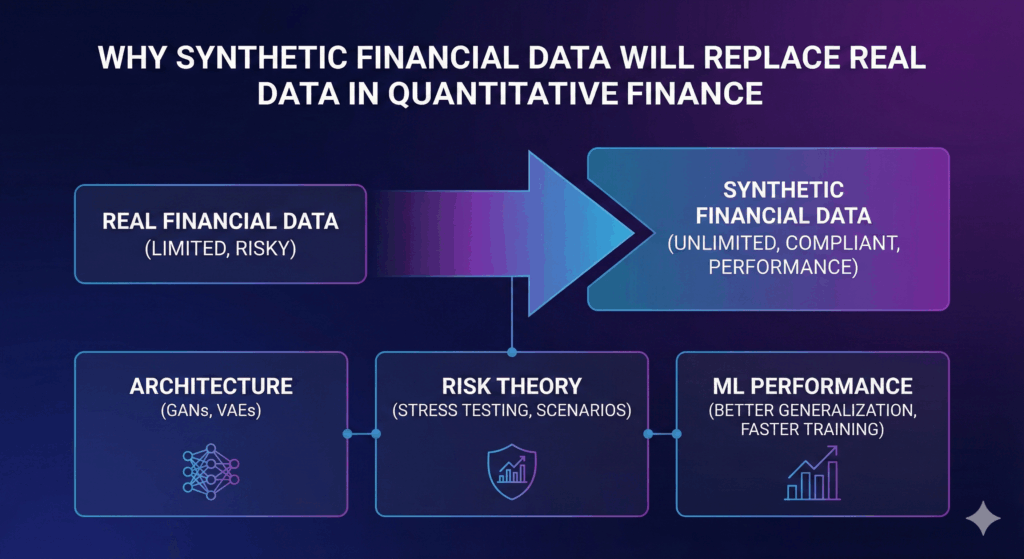
To generate new, realistic data, Northhaven utilizes a proprietary architecture based on generative adversarial networks (GANs). In this process of generating, two neural networks compete: one tries to generate fake data (the generator), and the other evaluates whether the data is real or artificial (the discriminator).
This generative adversarial method ensures that the synthetic dataset is indistinguishable from the original data in terms of correlations (e.g., EBITDA vs. Debt Service). Because the synthetic data is generated freshly, it eliminates real personal information.
From Real Data to Synthetic Data
The transition from real data to a synthetic dataset involves several steps:
- Ingestion: We analyze heterogeneous data points from disparate legacy systems.
- Modeling: Machine learning models learn the aspects of the data.
- Generation: We generate synthetic records derived from real data logic.
- Validation: We ensure statistical accuracy, so quantitative data matches the source.
Northhaven Use Cases: Quantitative Synthesis in Action
We do not offer generic SaaS. We provide dedicated solutions where data synthesis solves critical banking challenges.
1. Real Estate Credit Risk Model
In Real Estate finance, using real data for stress testing is slow due to privacy protocols. By using synthetic data, Northhaven allows banks to run thousands of quantitative studies on synthetic data. The scenario engine can provide a more precise estimate of Probability of Default (PD) by simulating market shocks.
We take a more interpretive approach to quantitative synthesis, allowing the model to synthesize complex variables like climate risk. This validates outcomes by measuring and counting the impact of specific stress events on LTV ratios, ensuring a precise estimate of the outcomes.
2. Covenant Risk & Monitoring
For Private Debt, we implement systematic monitoring. Synthesizing data allows us to predict covenant breaches months in advance. Because synthetic data reduces compliance friction, we can deploy analytics tools rapidly. The uncertainty of outcomes from individual borrowers is mitigated by generating synthetic trajectories of cash flow.
We analyze outcomes from individual studies of borrower behavior, aggregating individual studies by means of our C-CTGAN architecture. This functions as a filter for information that would normally be blocked by GDPR, specifically information that would otherwise compromise the bank’s internal firewalls.
3. Exit & Portfolio Scenario Model
When planning an exit, meta-analysis systematic review of the market is crucial. While a traditional meta-analysis is not possible on live private portfolios due to confidentiality, data synthesis bridges this gap. We create a synthetic dataset that allows for measuring and counting for uncertainty in market liquidity.
Our model calculates counting for uncertainty of outcomes, allowing Investment Committees to see the distribution of potential Internal Rates of Return (IRR). This qualitative data synthesis combined with quantitative rigor ensures that would otherwise compromise the confidentiality of the deal is never an issue.
Why Synthetic Data Techniques are Superior

Traditional literature reviews or qualitative research are insufficient for high-frequency trading or risk management. Synthetic data techniques offer a systematic alternative.
- Zero PII Risk: Since data is entirely artificially generated, there is no sensitive information.
- Speed: Using synthetic datasets accelerates test data creation for testing and development.
- Completeness: We can synthesize missing data points in heterogeneous datasets.
Addressing the Level of Complexity
Financial data is heterogeneous data. It comes data from different sources with varying structures. Rule-based data generation fails here. Northhaven’s ai-generated synthetic data handles this level of complexity by learning the deep latent structures of the real-world portfolio.
During the protocol development stage, we ensure the process of generating Title and metadata for each dataset is planned and documented. This documentation proves to regulators that the data processing methodology is sound and that the synthetic data may be safely used for training data.
Conclusion: The Future is Planned and Documented
Northhaven Analytics provides the data science infrastructure required for modern finance. By leveraging synthetic data generators and qualitative data synthesis, we enable banks to innovate without synthetic barriers.
Whether it is studies by means of statistical inference or deep machine learning, our data synthesis ensures you have the analytics you need. We describe the results through a lens of operational resilience, using means of statistical methods to validate every synthetic dataset.
data synthesis is not just a tool; it is the systematic future of secure, high-stakes decision-making.

