AI Risk Management: The Definitive Framework for Governance, Security, and Trustworthy AI
In the rapidly evolving landscape of artificial intelligence, the potential for innovation is matched only by the scale of the risk. As organizations developing or deploying AI rush to integrate AI systems into their core operations, they face a critical challenge: how to harness the power of AI technologies without exposing themselves to catastrophic liability.
AI risk management is not merely a compliance checkbox — it is a strategic necessity. Without a robust AI risk management framework, companies risk reputational damage, regulatory fines under the EU AI Act, and operational failure. The potential benefits of AI can only be realized if the downside is controlled.
In this comprehensive guide, we explore the principles of AI governance, dissect the NIST AI Risk Management Framework (NIST AI RMF), and outline risk management strategies for the entire AI lifecycle.
AI risk framework
functions
law
unaudited AI
What is AI Risk Management? Defining the Scope and Strategy
AI risk management is the systematic process of identifying, assessing, and mitigating the risks associated with AI throughout its lifecycle. Unlike traditional software, AI systems are probabilistic and can exhibit unpredictable behavior. Therefore, risk management requires a specialized approach that goes beyond standard IT security.
The Core Components of AI Governance and Strategy
AI governance provides the structure for AI risk management. It involves setting policies, defining roles, and ensuring accountability. Effective governance ensures that AI decisions align with organizational values and legal requirements.
Balancing Innovation with Risk Tolerance
Every organization has a different risk tolerance. Some may accept higher risks for faster innovation, while others prioritize safety. Effective AI risk management aligns AI projects with this tolerance. Risk management efforts should not stifle innovation but enable it by providing safe guardrails for developing and deploying AI.
AI risk management practices must be agile. The risks associated with AI systems change as the AI model evolves and encounters new data. Therefore, risk management processes must be continuous and iterative.
The AI Risk Landscape: Identifying Risks with AI Systems
To implement effective AI risk management, one must understand the specific AI risks involved. AI systems often introduce novel vulnerabilities that traditional risk frameworks miss.
AI models trained on biased training data will produce biased results. Risk management practices must include testing for disparate impact across protected groups. AI governance frameworks must explicitly address fairness — challenges often stem from historical biases embedded in data.
AI security involves attacks like data poisoning, model inversion, or evasion attacks. The security of AI systems must be hardened against adversarial inputs that could manipulate AI decisions. Security of AI is distinct from standard cybersecurity — it involves protecting the model's logic itself.
Trust in AI erodes when systems are "black boxes." AI risk management frameworks provide guidelines for ensuring transparency, allowing stakeholders to understand how an AI system arrived at a conclusion. If you cannot explain an AI decision, you cannot trust it.
AI technologies often rely on massive datasets. Managing AI risks involves ensuring that training data is collected and used in compliance with GDPR. Risk identification must include a thorough review of data lineage and consent. Risk assessment must identify if AI use violates privacy norms.
With the rise of generative AI, new AI risks have emerged. Hallucinations — where an AI model confidently states falsehoods — can lead to misinformation and regulatory exposure. Additionally, the risk of Intellectual Property (IP) theft via training data is significant. Risk mitigation for GenAI involves rigorous fact-checking layers and copyright audits.
Frameworks for Success: The NIST AI Risk Management Framework (AI RMF)
A comprehensive AI risk management framework is essential for navigating this complexity. The NIST AI Risk Management Framework (NIST AI RMF) has emerged as the global gold standard for managing AI risks. It provides a flexible structure for organizations developing or deploying AI.
The 4 Functions of the NIST AI RMF: Govern, Map, Measure, Manage
The NIST AI RMF organizes risk management activities into four core functions that should be applied throughout the AI lifecycle:
This function focuses on cultivating a culture of risk management at the leadership level. Finance leaders and the C-suite must define the organization's risk tolerance and AI strategy. Without governance, all other functions are performative.
This involves documenting the AI lifecycle, intended purpose, and potential impacts. Mapping helps in identifying existing risk and new vectors. You cannot govern what you have not mapped.
Using quantitative and qualitative metrics to assess AI risks. Risk assessment tools are critical here to quantify artificial intelligence risk. Gut feeling is not a risk management strategy.
This is where risk mitigation occurs. Organizations must allocate resources to manage risk based on the severity identified in the Measure phase. By adopting the NIST AI RMF, organizations ensure they are developing or deploying AI systems responsibly.
Regulatory Compliance: The EU AI Act and Global AI Standards
AI risk management is no longer voluntary — it is becoming law. The EU AI Act categorizes AI systems based on risk levels, mandating specific risk management processes for each tier.
Prohibited outright. Real-time biometric surveillance in public spaces. Social scoring by governments.
Credit scoring, employment decisions, critical infrastructure. Mandatory risk management, human oversight, auditability.
Chatbots, deepfakes. Transparency obligations — users must know they are interacting with AI.
AI-enabled video games, spam filters. Minimal obligations. Voluntary codes of conduct encouraged.
High-risk AI systems (e.g., in employment, credit scoring, or critical infrastructure) require strict risk management processes, robust data governance, and human oversight. A robust AI risk management strategy is the only defense against regulatory penalties.
Ensure that AI complies with these laws by integrating compliance checks into the AI development pipeline. AI risk management practices must be auditable and documented. AI systems throughout their lifecycle must adhere to these evolving standards.
Implementing AI Risk Management: Strategies for the Entire AI Lifecycle
Implementing AI risk management requires embedding controls throughout the AI lifecycle — from design to decommissioning. It is not a one-time event.
Risk identification starts early. AI development teams must vet training data for bias and quality. Responsible AI practices dictate that data should be representative and legally sourced. Risk assessment and mitigation planning should happen before a single line of code is written.
During training, risk management practices focus on validation. AI tools can be used to stress-test the AI model against adversarial attacks. Security risk assessment should be continuous. Developing or deploying AI systems without rigorous testing invites failure.
Deploying AI systems introduces new risks related to real-world interactions. Monitoring AI use in the real world is crucial to detect drift or unintended consequences. Effective risk management requires a feedback loop where production issues inform future risk management strategies.
Addressing "Shadow AI" and Third-Party Risks
One of the biggest challenges is "Shadow AI" — the unauthorized use of AI tools by employees. AI risk management must address this by establishing clear policies on acceptable AI use.
Many organizations use third-party AI models. Risk management requires vetting these vendors. Do they follow responsible AI principles? Is their AI security robust? Managing AI risks extends to the supply chain.
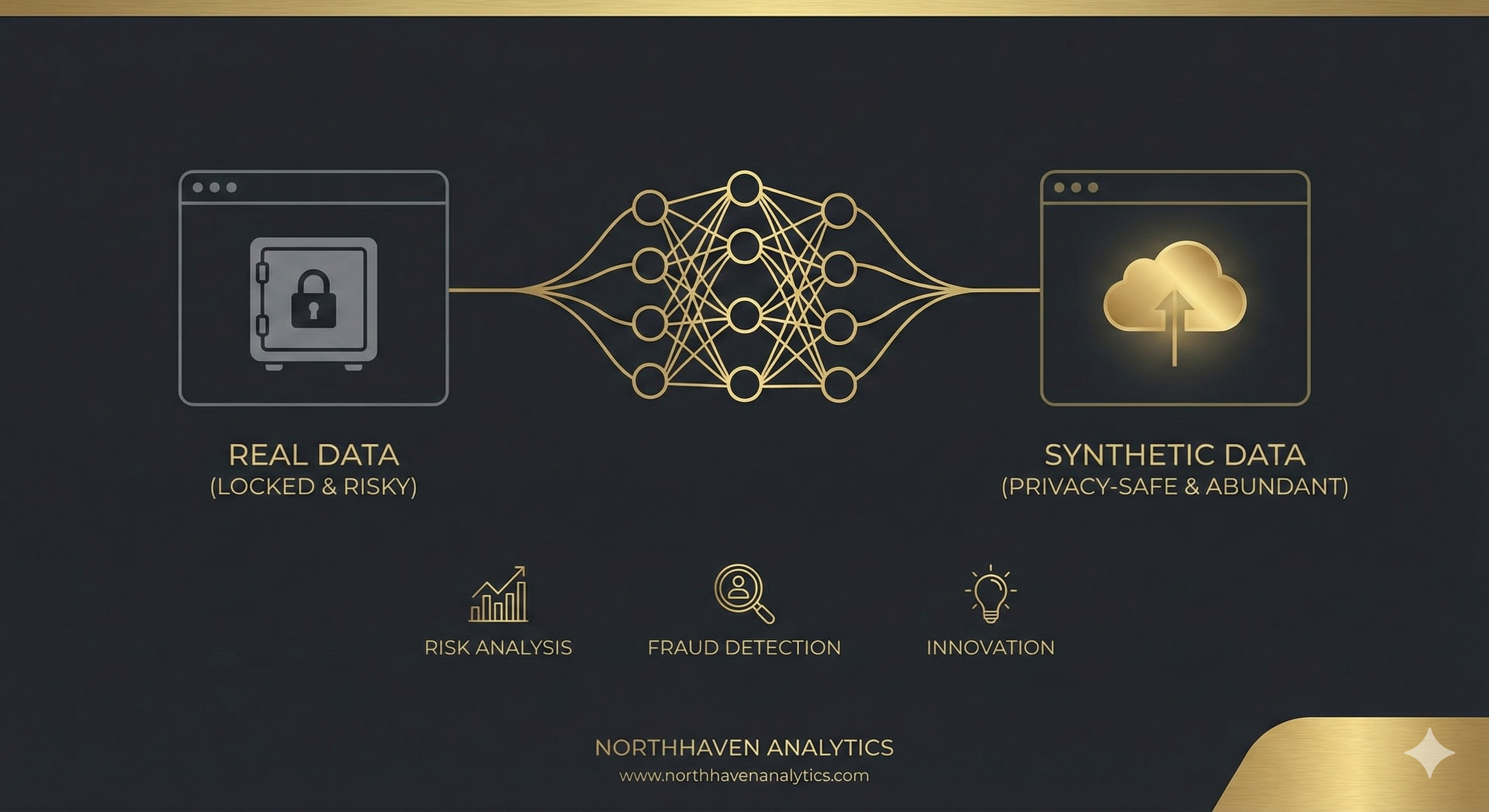
The Northhaven approach to lifecycle risk: Synthetic data solves a critical lifecycle risk problem — at every phase, real data creates liability. Northhaven generates statistically identical synthetic training data that is GDPR-safe, bias-correctable, and fully auditable, enabling teams to train, test, and validate AI models without ever touching a real customer record.
Best Practices for Trustworthy AI and Responsible AI
Building trustworthy AI requires a commitment to responsible AI. These principles should be non-negotiable in any AI deployment.
For high-stakes decisions, ensure human oversight. AI decisions should ultimately be accountable to humans — especially in credit, employment, and medical contexts regulated by the EU AI Act.
Regularly audit AI systems for bias and performance degradation. Models drift as the world changes — a model trained in 2023 may be dangerously miscalibrated by 2026 without active monitoring.
Involve diverse voices in the risk assessment process to identify blind spots. The people affected by AI decisions — customers, employees, regulators — must have representation in governance structures.
Integrate AI security protocols from day one to protect the security of AI systems. Retrofitting security after deployment is exponentially more expensive and less effective than building it in from the start.
Strategic Risk Management: Balancing Innovation and Safety
AI adoption should not be stifled by fear. Effective AI risk management enables innovation by providing guardrails. By managing AI risks, organizations can harness the power of AI with confidence.
Risk management frameworks like Google's Secure AI Framework or the NIST AI RMF provide the scaffolding. However, the culture must shift. AI risk management strategy must be aligned with the broader business strategy. Implementing AI risk management transforms compliance from a cost center into a competitive advantage.
Risk assessment and mitigation should be viewed as enablers of AI applications, not blockers. Risk management frameworks create a safe space for experimentation. As AI technologies advance, the risks with AI systems will evolve — generative AI introduces new vectors like hallucinations and deepfakes, requiring continuously updated risk mitigation strategies.
At Northhaven Analytics, we provide the infrastructure — including synthetic data — to help you validate and secure your AI models. Synthetic training data is inherently bias-correctable, GDPR-safe, and fully auditable. It is the single most effective tool for addressing data quality, privacy, and fairness risks simultaneously — before a model ever touches production.
The Future of AI Governance and Risk
Organizations that master AI risk management practices will lead the market. They will be the ones developing and deploying AI that is safe, effective, and trusted. Trust in AI systems is the ultimate competitive advantage.
Whether you are using generative AI or traditional predictive models, a robust approach to AI risk management is essential. Existing risk management frameworks must evolve to accommodate the unique challenges posed by AI technologies. AI use cases will continue to expand — and so must our vigilance.
Northhaven Analytics
Secure your AI models with synthetic data infrastructure. GDPR-safe. Bias-correctable. Fully auditable. Ready for the EU AI Act.
Explore AI Risk Solutions →