By Northhaven Analytics Research Team
Introduction: Why Machine Learning Has Become the Engine of the AI Revolution
We are living in the age of artificial intelligence, but the engine driving this revolution is machine learning. From recommendation engines to autonomous vehicles, machine learning has become the fundamental technology underpinning modern innovation. It is no longer just a buzzword; machine learning is important because it allows organizations to scale decision-making processes that were previously impossible for humans to manage manually.
Machine learning is a subset of AI that focuses on building systems that learn from data. Unlike traditional software engineering, where rules are explicitly programmed, a machine learning system uses statistical models to identify patterns and make decisions with minimal human intervention. As machine learning and artificial intelligence continue to converge, the ability to use machine learning to analyze complex datasets is becoming a prerequisite for industry leadership.
In this comprehensive guide, we will explore how machine learning works, dissect the various types of machine learning algorithms, and examine how data science and machine learning intersect to solve complex learning problems. Whether you are looking to build machine learning models or understand the evolution of machine learning, this article covers the entire spectrum of machine learning technology.
What is Machine Learning? Defining the Goal of Machine Learning
At its core, machine learning is the science of getting computers to act without being explicitly programmed. The goal of machine learning is to understand the structure of data and fit that data into models that can be understood and utilized by people.
Machine learning can analyze vast datasets to uncover hidden insights. A machine learning algorithm (or learning algorithm) is a mathematical method used to parse data, learn from it, and then make a determination or prediction about new data. When machine learning combined with big data analytics is deployed, it creates a powerful predictive engine.
Distinguishing Between AI, Machine Learning, and Deep Learning
It is crucial to distinguish between AI and machine learning and machine learning and deep learning.
- Artificial Intelligence is the broad umbrella term for machines capable of mimicking human intelligence. AI systems often incorporate ML but can also include rule-based engines.
- Machine Learning is the subset involving statistical techniques to enable machines to improve at tasks with experience. Modern machine learning relies heavily on statistical inference.
- Deep Learning is a specialized subset of ML that uses neural networks with many layers (hence „deep”) to simulate human decision-making. Deep learning requires vast computational power and massive datasets.
How Machine Learning Works: The Machine Learning Process

The machine learning process begins with observations or data, such as examples, direct experience, or instructions. The learning process involves looking for patterns in data to make better decisions in the future.
Models are trained using training data. A machine learning model (or ml model) is the mathematical artifact created by the training process. To train models, data scientists typically split their data into training and testing sets. The learning algorithm processes the training data to find patterns.
Learning requires high-quality data. If the input is garbage, the output will be garbage. Machine learning also involves a feedback loop; as new data is fed into the system, the model refines its predictions. Learning trains the system to recognize deviations and adapt its internal weights.
Learning Paradigms: Types of Machine Learning Algorithms
There are several learning paradigms depending on the nature of the data and the desired outcome. While there are many variations, we categorize them into distinct machine learning methods.
1. Supervised Machine Learning Models and Algorithms
Supervised learning is the most common paradigm in the industry. In supervised machine learning, the machine learning algorithm is trained on labeled data. This means the data comes with the correct answer attached. The model learns the mapping function from the input variables to the output variable.
Supervised learning algorithms are used when the outcome is known. Supervised learning uses input-output pairs to adjust the model.
- Linear Regression: A type of supervised learning used for predicting continuous values (e.g., predicting revenue).
- Logistic Regression: Used for binary classification tasks (e.g., spam vs. not spam).
- Classification: Algorithms that categorize data into specific classes.
- Support Vector Machines (SVM): Powerful for high-dimensional data.
Supervised machine learning models are essential for tasks like credit scoring, where historical data provides clear „default” or „no default” labels.
2. Unsupervised Machine Learning and Data Discovery
Unsupervised machine learning deals with unlabeled data. The goal is to model the underlying structure or distribution in the data in order to learn more about it. Unsupervised learning algorithms are left to their own devices to discover and present the interesting structure in the data.
Common unsupervised learning tasks include:
- Clustering: Grouping a set of objects in such a way that objects in the same group are more similar to each other (e.g., K-Means).
- Dimensionality Reduction: Reducing the number of random variables under consideration (e.g., PCA), which helps when machine learning can analyze high-dimensional financial data.
Unsupervised learning algorithms are critical for anomaly detection and customer segmentation where we don’t know the segments in advance.
3. Reinforcement Machine Learning and Autonomous Agents
Reinforcement machine learning is a type of machine learning where an agent learns to behave in an environment by performing actions and seeing the results. Reinforcement learning algorithms use a system of rewards and penalties.
Reinforcement learning differs from supervised learning in that there is no answer key. The learning algorithm decides what to do to perform the task.
- Game Playing: Machine learning using the game of Go (AlphaGo) demonstrated the power of reinforcement learning to solve complex strategic problems.
- Robotics: Robots use reinforcement learning to learn how to walk or grasp objects.
Studies in machine learning using reinforcement techniques show it is the closest representation of how humans learn—through trial and error.
4. Semi-Supervised and Self-Supervised Learning
Semi-supervised learning falls between supervised and unsupervised learning. It uses a small amount of labeled data with a large amount of unlabeled data. This is useful when labeling data is expensive. Self-supervised learning is an autonomous form of learning where the system generates its own supervisory signals from the data itself, a technique heavily used in Large Language Models.
Deep Learning and Neural Networks: When Machine Learning Goes Deep

Deep learning models are artificial neural networks with many layers. Deep learning requires vast amounts of data and substantial computing power (GPUs/TPUs). Unlike traditional machine learning, which may plateau with more data, deep learning performance continues to improve as data analysis scales.
A neural network consists of layers of interconnected nodes. Learning employs backpropagation to adjust the weights of the network based on the error rate.
- Applications of machine learning in this domain include Large Language Models (LLMs), computer vision, and speech recognition.
- Machine learning and deep learning are driving the current boom in Generative AI. Deep learning requires architectures like CNNs (for images) and Transformers (for text).
Amounts of data deep learning systems consume are staggering, often in the petabytes. This allows them to learn features directly from data without manual feature extraction.
Developing a Machine Learning Project: The Lifecycle
A typical machine learning project follows a rigorous lifecycle. Success depends on how well the team executes each phase.
- Data Collection: Gathering large amounts of data from diverse sources.
- Data Preprocessing: Cleaning and formatting data. Machine learning can analyze messy data, but clean data yields better results.
- Feature Engineering: Selecting the right variables to feed the learning algorithm.
- Model Selection: Choosing the right ml model or learning algorithm (e.g., choosing between regression algorithms or decision trees).
- Training: Learning trains the model on the data. Learning models are trained iteratively until they converge.
- Evaluation: Testing the model on unseen data to check for overfitting.
- Deployment: Integrating the machine learning system into production to handle new data.
Automated machine learning (AutoML) tools are now emerging to simplify this workflow, allowing non-experts to use machine learning to build effective models rapidly. Machine learning libraries like TensorFlow, PyTorch, and Scikit-learn provide the building blocks for these learning projects.
Machine Learning Applications and Use Cases in Industry
Machine learning use is ubiquitous. Machine learning use cases span every sector, transforming how businesses operate.
- Finance: Machine learning applications include algorithmic trading, credit scoring, and fraud detection. Financial institutions use machine learning to assess risk and detect anomalies in large amounts of data.
- Healthcare: Machine learning helps diagnose diseases from X-rays and personalize treatment plans. Learning focuses on patient outcomes.
- Marketing: Machine learning combined with CRM data enables hyper-personalization.
- Security: Machine learning can analyze network traffic to detect cyberattacks in real-time.
Machine learning technology allows AI systems to adapt to new threats and opportunities instantly.
Challenges: Bias, Data, and Complexity
Despite its power, machine learning faces challenges.
- Bias in Machine Learning: This occurs when training data reflects existing prejudices. Learning algorithms learn from what they are fed; if the data is biased, the machine learning program will be biased.
- Data Scarcity: Learning requires massive datasets. Many machine learning projects fail because they lack sufficient labeled data.
- Interpretability: Complex statistical models like deep neural networks are often „black boxes.”
Machine learning works best when these challenges are managed through robust governance and data engineering.
The Evolution and History of Machine Learning
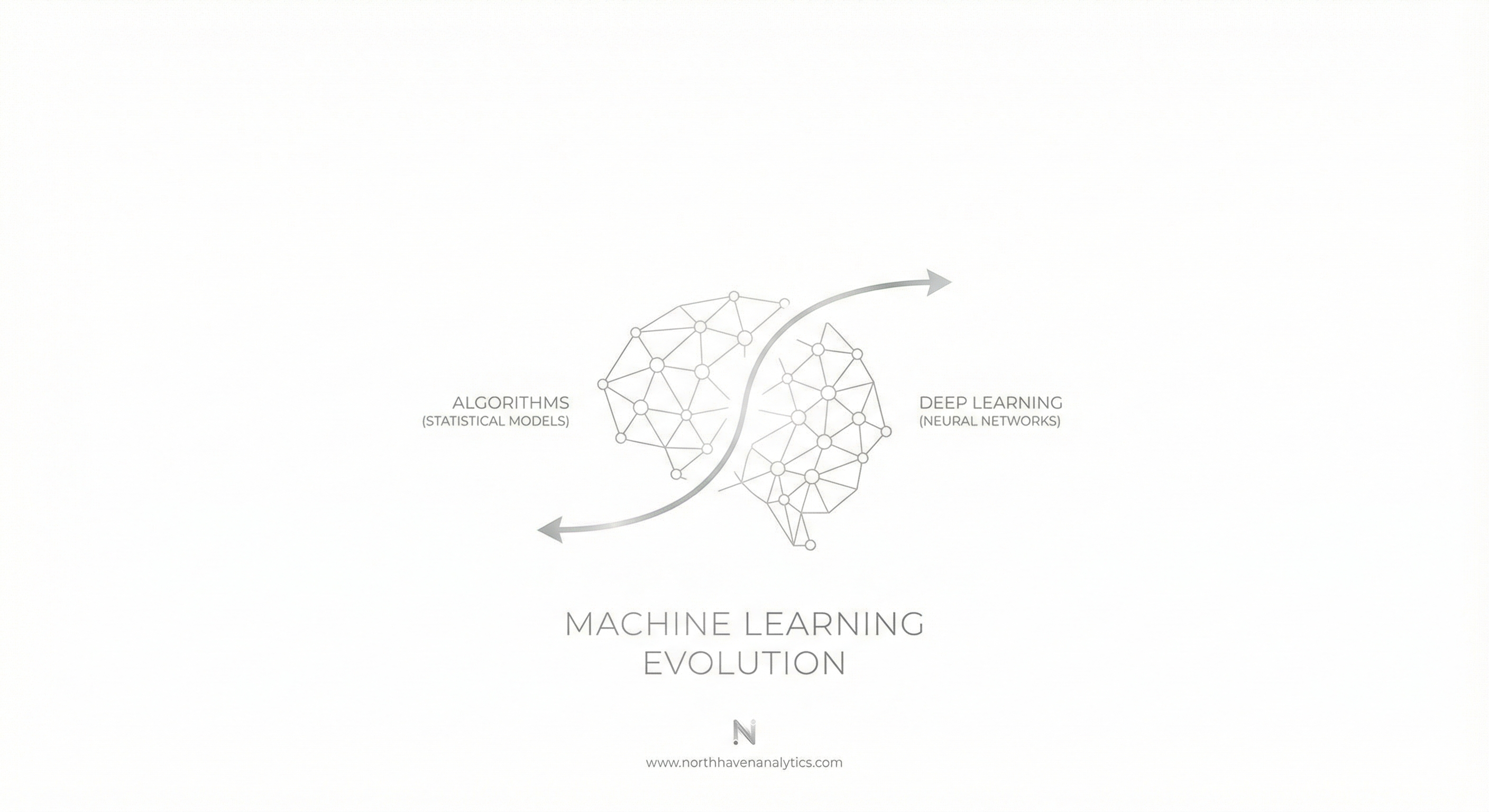
The history of machine learning has moved from simple statistical models (like perceptrons) to complex AI and machine learning ecosystems. Machine learning has become the primary driver of technological progress in the 21st century.
Popular machine learning techniques continue to evolve. From early supervised learning uses in simple classification to modern ensemble learning (like XGBoost) and reinforcement learning in autonomous agents, the field is expanding. Learning projects are becoming more ambitious, tackling problems like protein folding and climate modeling.
To succeed in the future, organizations must understand machine learning methods. Whether you use a learning program for internal analytics or build a sophisticated machine learning model for a consumer app, the principles remain the same.
Machine learning is a subset of computer science that is redefining what is possible. By leveraging machine learning tools, Northhaven Analytics helps clients navigate this complex landscape, ensuring that machine learning serves business goals effectively.