The global financial sector is shifting toward a new data paradigm. Specifically, synthetic data is no longer viewed as an auxiliary tool. Instead, it is the structural backbone of modern machine learning. Indeed, this shift is not ideological. Rather, it is mathematical.
Finance has reached a critical point. Currently, real datasets cannot meet the scale required by advanced AI systems. Furthermore, they lack the necessary flexibility. Consequently, synthetic data solves this problem. It offers an unlimited, privacy-safe alternative. Moreover, it remains structurally coherent. Ultimately, it behaves like real financial behaviour.
For the first time, quantitative researchers can train high-performance models. Crucially, they can do this without touching regulated data. This applies to banks, hedge funds, and fintech innovators. Because synthetic financial data is generated through a finance-first architecture, it is superior. Specifically, its correlations reflect the underlying mechanics of real markets. Therefore, it is not random noise.
Northhaven Analytics is at the forefront of this transformation. In fact, we are building a proprietary synthetic data engine. Notably, it is specifically engineered for financial systems. (Read about our Launch Announcement)
What Synthetic Data Really Means for Finance — Beyond the Buzzword
Unfortunately, most discussions around synthetic data reduce it to a generic concept. For instance, they define it as “AI-generated datasets that look like real data.” However, this shallow definition misses the core. In reality, true synthetic financial data replicates structure. Furthermore, it captures dependencies and behavioural patterns. Crucially, it does so without referencing any private information.
Real financial datasets suffer from three fundamental limitations. First, they are restricted by GDPR. Second, they are structurally incomplete. Finally, they are anchored to historical regimes. Consequently, these regimes no longer represent the present or future.
Therefore, synthetic financial data generation bypasses these limitations. It achieves this by reconstructing the underlying processes. It does not merely copy specific historical instances.
For financial institutions, this means freedom. Specifically, the ability to model risk, credit, and liquidity. Moreover, they can analyze market dynamics with unprecedented freedom.

The Architecture Behind High-Fidelity Synthetic Financial Data Generation
Synthetic data has existed for years. However, its application to finance has been constrained. This is due to the limitations of general-purpose GAN models. In response, Northhaven Analytics designed a new engine. Specifically, it moves beyond tabular imitation. Instead, it captures financial logic at the architectural level.
The core of this approach is unique. It blends a CTGAN-inspired synthesizer with convolutional layers. These layers extract long-range behavioural patterns from transactional sequences. Unlike traditional tabular synthesis, convolution allows interpretation. For example, it interprets temporal dynamics. This includes seasonal spending and credit cycles. Additionally, it covers delinquency progression and liquidity behaviour. Ultimately, all are essential for producing synthetic data that behaves like real financial systems.
A key innovation in Northhaven’s architecture is the discriminator. It acts as a financial auditor rather than a binary classifier. Specifically, it evaluates synthetic data based on structural consistency. Furthermore, it checks behavioural logic and cross-feature dependencies. Finally, it verifies the integrity of risk progression. This ensures that synthetic data is financially coherent. It is not merely statistically plausible. (See our Technical Breakdown)
Why Synthetic Financial Data Often Outperforms Real Data
It may sound counterintuitive. However, synthetic data frequently produces better machine learning performance than real datasets. This is because real financial data is riddled with operational noise. In addition, it contains missing values and legacy system irregularities. Furthermore, it suffers from survivorship bias.
Synthetic data eliminates these artefacts. Consequently, it provides a clean, structurally consistent dataset. More importantly, synthetic data generation allows researchers to expand datasets. They can go beyond historical limitations. Instead of a single economic cycle, synthetic data can reflect multiple regimes. Therefore, it compensates for the non-stationarity of real markets.
Models trained on Northhaven’s synthetic financial data show impressive results. Specifically, performance metrics are extremely close to real-data baselines. Sometimes, they even surpass them. This is particularly true in tasks involving behavioural prediction and risk modelling.
Synthetic Data and the End of GDPR Friction
For many institutions, the greatest barrier to innovation is not technological. Rather, it is regulatory. Accessing granular data requires layers of legal review. Additionally, it demands anonymization workflows. Furthermore, data-governance approvals are mandatory. Synthetic data removes these barriers entirely.
Because synthetic financial data contains no personal information, it is safe. Moreover, it has no traceable records. Therefore, it falls outside GDPR constraints. This allows quants and data scientists to iterate freely. They can work without waiting for approvals. Also, they avoid risking data exposure.
In summary, synthetic data shifts the bottleneck. It moves from legal clearance to pure research velocity. Consequently, this redefines competitive advantage in the financial sector. (Learn about our Data Validation and Advisory)
How Synthetic Data Enables Counterfactual Finance and Stress Modelling
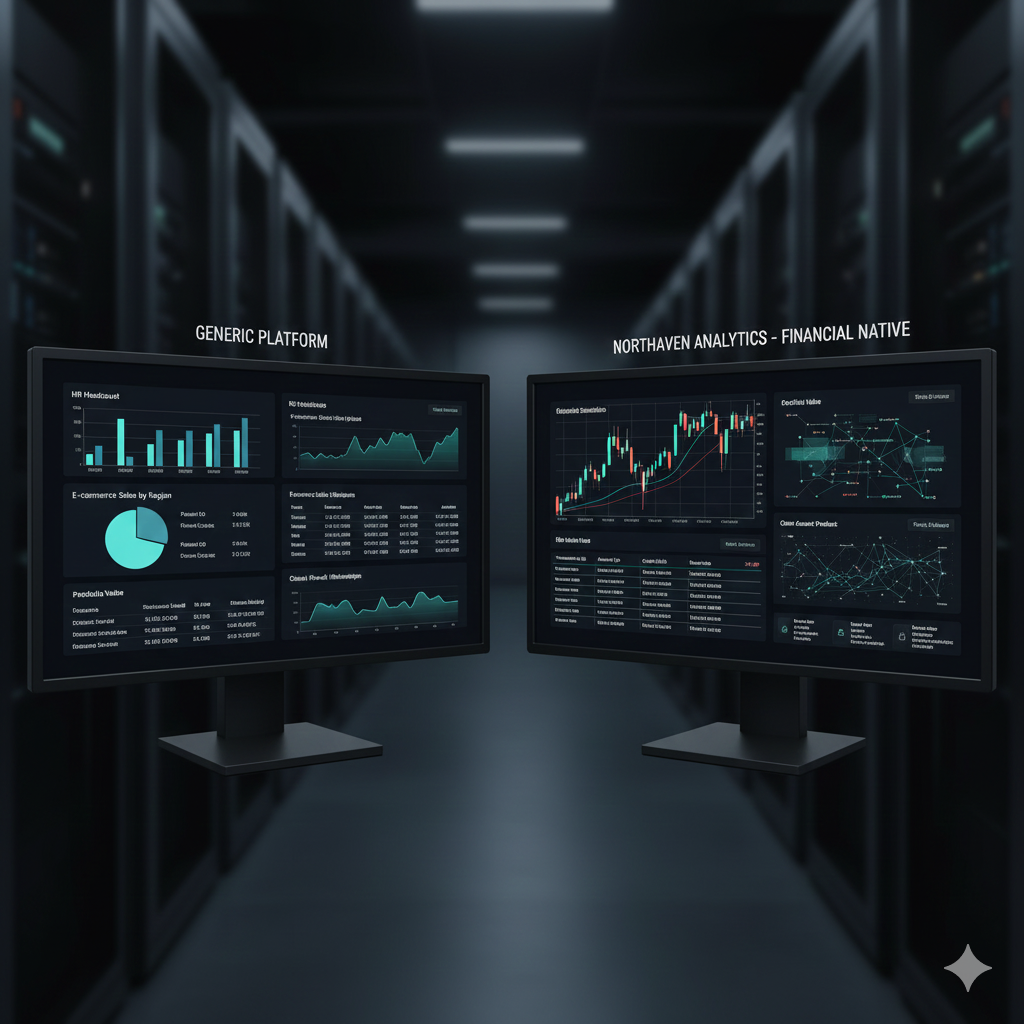
What distinguishes Northhaven from generic synthetic data vendors? It is the explicit modelling of financial dependencies. Instead of creating datasets that merely resemble banking tables, we go deeper. Northhaven generates synthetic financial data that preserves the underlying structure.
The engine learns:
- Credit-risk gradients.
- Behavioural decay curves.
- Cross-table liquidity flows.
- Repayment logic.
- Temporal transaction dynamics.
- Conditional dependencies between income, risk, region, and behaviour.
Synthetic data, when built with this level of domain intelligence, evolves. It becomes a superior tool for financial modelling. (Meet the Founders behind this vision)
Northhaven Analytics: A Finance-First Approach to Synthetic Data
What distinguishes Northhaven from generic synthetic data vendors is the explicit modelling of financial dependencies. Instead of creating datasets that merely resemble banking tables, Northhaven generates synthetic financial data that preserves the underlying structure of financial behaviour.
The engine learns:
- credit-risk gradients,
- behavioural decay curves,
- cross-table liquidity flows,
- repayment logic,
- temporal transaction dynamics,
- conditional dependencies between income, risk, region and behaviour.
Synthetic data, when built with this level of domain intelligence, becomes not just a replacement for real data but a superior tool for financial modelling.
The Future: Synthetic Data as the Default Infrastructure of Finance
Within the next decade, synthetic financial data will not be an innovation. Rather, it will be an expectation. Financial institutions will build AI pipelines differently. They will not build around regulated, limited data. Instead, they will build around generative architectures. These are capable of expressing entire financial ecosystems.
Northhaven Analytics aims to lead this transition. We do this with a proprietary engine. It merges finance theory, machine learning, and data engineering. Ultimately, it creates a unified synthetic data ecosystem.
The future of finance will not be built on historical datasets. It will be built on synthetic data that surpasses history.
Conclusion
Synthetic data is not a trend. It is a structural necessity for modern financial AI. As regulatory constraints tighten, demand grows. Consequently, synthetic financial data generation is emerging as the only pathway. It is capable of supporting scalable, flexible, and compliant quantitative research.
Northhaven Analytics is building the engine for that future. It is a finance-first synthetic data system. Specifically, it is engineered to redefine how financial institutions model risk.
The next decade of finance belongs to synthetic data. And the companies that adopt it early will lead the transformation.
Start Your Transformation Today