

AI Agent and Autonomous Systems: How Advanced Coding, Agentic AI, and Enterprise Use Cases Fundamentally Transform the Modern Corporate Workflow
MAJOR COMPANY UPDATE: Northhaven Analytics is extraordinarily proud to announce a monumental, industry-defining expansion of our deep-tech infrastructure. Historically, our Generative AI and synthetic data engines were the exclusive, closely guarded secret of top-tier Wall Street banks. Today, we are completely shattering those boundaries.
Northhaven now officially generates mathematically perfect synthetic data and builds bespoke Custom Machine Learning Models for absolutely every sector in the global economy. Today, we are focusing all our unparalleled technological firepower on the absolute pinnacle of technological evolution: the autonomous AI agent.
operation window
execution speed
of AI agents
in synthetic training
From Generative AI to Agentic AI: The Most Significant Technological Leap of the Decade
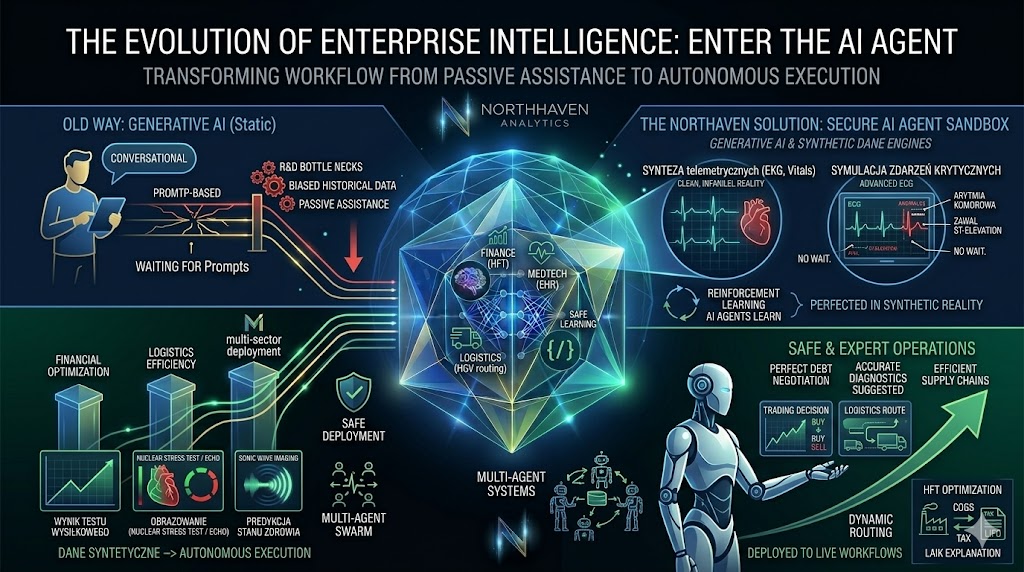
In the rapidly evolving, hyper-competitive landscape of the global digital economy, a successful enterprise must aggressively use AI to survive and outpace its rivals. However, simply using a static AI model or relying on a passive chatbot is no longer sufficient to maintain a competitive edge. The era of conversational AI assistants merely waiting for human prompts is permanently over.
We have entered the unprecedented era of the autonomous agent. The immense demand to fundamentally automate a complex corporate workflow has created an insatiable hunger for pristine, highly structured training data. You cannot safely deploy AI agents if they are trained on biased, incomplete historical records. This is exactly where Northhaven Analytics steps in.
Static models that wait for human prompts. They generate outputs on demand but take no autonomous action in the world. Useful — but increasingly insufficient for enterprises that need to scale.
AI agents that perceive their environment, make independent decisions, and take direct action to achieve goals — without human intervention. This is the monumental shift that defines the next decade of enterprise technology.
We provide the limitless, synthetic data foundation required to rigorously build AI agents that safely and autonomously execute complex tasks at scale. We automate the generation of secure, statistically perfect market and operational environments, ensuring that your infrastructure can extract actionable intelligence — allowing AI agents to safely explore, learn, and optimize their decision-making pathways without ever risking live capital or restricted data on untested code.
Exploring the Distinct Types of AI Agents
The architecture of these advanced systems is not monolithic. There are numerous distinct types of AI agents utilized in enterprise environments depending on the exact nature of the task. Understanding these categories is critical for the proper deployment of AI agents across your organization.
The most basic algorithms designed for immediate response. A simple reflex agent uses condition-action rules to make instantaneous decisions. They only respond to the current perception and completely ignore the rest of the history. For example, in cybersecurity, a simple reflex agent might instantly block an IP address if it detects a specific malicious signature, without analyzing the broader context.
These agents operate with an internal state, allowing them to handle environments that are only partially observable. Model-based reflex agents keep track of the part of the world they cannot see right now. The AI agent updates its internal model based on new inputs over time, allowing it to navigate complex logistics chains where variables are constantly shifting out of view.
These agents possess detailed information about desirable situations and ultimate objectives. Goal-based agents search for sequences of actions that achieve a specific goal, such as finding the most efficient route for a delivery truck considering live traffic, fuel costs, and driver hours. They plan their actions by considering the future consequences of their current choices.
When multiple safe outcomes exist but some are much better than others, utility-based agents calculate which state provides the highest utility or overall profit. They heavily rely on advanced AI and machine learning to maximize efficiency, commonly used in algorithmic trading where an agent must choose the trade that offers the highest return for the lowest risk.
The absolute most powerful AI agents available today. These agents improve over time by continuously evaluating their past performance against predefined success metrics. As they gather more data and experience, they refine their algorithms, ensuring that the agents continuously adapt to new challenges and market shifts.
Key Components of an AI Agent Architecture
To effectively integrate an advanced AI system into your corporate infrastructure, your engineering and data science teams must deeply understand the key components of AI agent design. The core components of an AI agent architecture dictate exactly how the system perceives its surroundings, reasons through problems, and ultimately acts upon the world.
The agent must perceive its environment through highly calibrated sensors, which in the digital world typically manifest as APIs, web scrapers, or direct database connections. This is the raw intake layer — the agent’s eyes and ears in the digital landscape.
The AI agent analyzes this vast influx of input using an advanced AI model such as a Large Language Model or a deep neural network. This analytical phase is where the agent attempts to map the current state of the world — correlating signals across data sources to form a coherent picture.
The agent must determine the absolute best course of action. This reasoning phase makes AI agents exceptionally powerful, but also exceptionally dangerous if not properly aligned with corporate goals. This is where Northhaven’s synthetic sandboxes become mission-critical.
Finally, the agents act upon the environment through actuators — executing trades, sending emails, or reallocating servers. When we deploy AI agents, they immediately begin to alter the digital landscape. An AI agent’s primary function is to execute a continuous, flawless perception-action loop.
The Northhaven Sandbox Guarantee: To guarantee responsible AI development and deployment, Northhaven provides incredibly robust synthetic sandboxes where agents continuously loop through their programming without interacting with live, sensitive data. This completely eliminates the risk of an agent hallucinating and deleting production records.
Coding Powerful AI Agents: How Agents Work Together in a Sophisticated Multi-Agent System
The physical and digital process of coding these autonomous systems requires profound, specialized expertise. When you use an AI to write code, manage databases, or execute complex API calls, you are fundamentally shifting from manual human operation to autonomous digital execution.
However, a single, isolated agent is inherently limited in its scope. The true power of AI is unlocked only when developers string together multiple AI agents into a unified, communicative swarm.
Scrapes global news feeds, monitors market signals, and aggregates raw data from dozens of sources simultaneously — feeding the pipeline in real time.
Receives raw sentiment numbers and market data, crunches them against historical models, and passes final findings to the execution layer with confidence scores attached.
Acts on the analytical findings with microsecond precision — placing trades, triggering workflows, or escalating anomalies to human oversight teams when confidence thresholds are breached.
In a highly advanced multi-agent system, agents can process vastly different parts of a complex problem simultaneously. These agents interact with other agents, dynamically negotiating, sharing critical data, and autonomously resolving conflicts to reach a consensus. By aggressively training your AI on Northhaven’s pristine synthetic feeds, your developers learn to instantly detect deadly anomalies and ensure that when your agents act, they do so safely and logically.
Essential AI Agent Use Cases: How Organizations Automate Operations at Scale
The absolute core of any modern digital strategy is the continuous, automated monitoring of execution risk. When evaluating the immense value and ROI of this technology, we must look at highly concrete use cases. Organizations use AI agents to fundamentally restructure how their businesses operate, drastically reducing overhead while multiplying output.
Elite quantitative hedge funds and major investment banks rely heavily on agents specializing in High-Frequency Trading (HFT) and algorithmic arbitrage. These agents execute complex buy and sell orders in mere microseconds, reacting to market news faster than any human could comprehend. Northhaven’s synthetic order books allow safe practice during simulated market crashes.
AI agents automate the incredibly complex routing of massive global shipping fleets and trucking networks. These autonomous agents continuously negotiate port fees, monitor global weather patterns, and optimize fuel consumption dynamically — rerouting multi-million dollar operations instantly when geopolitical crises occur.
Sophisticated AI agents constantly patrol corporate networks, acting as a tireless immune system. When a zero-day attack is detected, these agents can lock down servers, isolate malware, and rewrite firewall rules faster than any human security team could ever react.
Agents that automate mundane and repetitive tasks completely free up human capital for true, high-level innovation. AI agents improve operational efficiency exponentially, turning sluggish corporations into agile, data-driven powerhouses that never sleep and never fatigue.
Maximizing the Benefits of AI Agents While Overcoming the Challenges
While the benefits of AI agents are monumental — limitless scalability, absolute zero fatigue, and hyper-fast execution speeds — the challenges of using AI agents are equally severe and must be addressed head-on.
The most glaring issue is the inherent danger of hallucinations, data poisoning, or catastrophic goal misalignment. If a trading agent hallucinates a profitable trend and executes it with maximum leverage, hundreds of millions of dollars can vanish in seconds. If an institution deploys a model it does not fully understand, it invites total ruin.
Because severe market crashes and potential black swan risks are historically rare in live data, firms simply do not have enough real-world examples to effectively train their AI to survive them. Northhaven synthesizes millions of these exact emergencies — ensuring agents learn from synthetic mistakes, not real-world catastrophes.
When multiple agents operate simultaneously, coordination failures can cascade across the entire system. Agents must be rigorously tested for conflict resolution, data handoff integrity, and consensus-building under adversarial conditions — all safely achievable within Northhaven’s synthetic environments.
Why Powerful New AI Agents Will Become the Industry Standard
When you leverage technology to artificially induce a massive portfolio rebalance or orchestrate a complex supply chain shift, you quickly realize that agents are helpful only when they are highly reliable and predictable. Understanding exactly how AI agents are built means acknowledging that every single autonomous action carries inherent risk. The goal is not to eliminate action, but to perfectly manage the risk associated with it.
To mitigate this systemic risk, Northhaven Analytics empowers your enterprise to securely build the software that makes these critical, split-second decisions. We provide the mathematical certainty required to evaluate the adequacy and safety of any deployed agent.
Looking forward to the end of the decade, agents will become the foundational layer of absolutely all enterprise software. The shift is inevitable and already underway across every major sector of the global economy.
While human agents will always be required for high-level strategic oversight, empathetic client relations, and moral governance, the vast majority of heavy data processing, code generation, and direct task execution will be handled by AI.
The advanced AI tools currently used by elite clients prove that the aggressive deployment of these systems is no longer optional — it is mandatory for survival. An enterprise must deploy specialized AI agents to remain competitive in a landscape that never sleeps.
To use AI agents effectively and safely, you must provide them with the greatest, most secure training data on earth. Northhaven provides the flawless synthetic foundation your enterprise demands — so your agents conquer the real world without risk.
The bottom line: The concept of AI agents to automate workflows and understand complex, unstructured data are no longer science fiction or academic theory. Agents are built today to solve the impossible problems of tomorrow. Northhaven Analytics provides the perfect synthetic reality; your AI agents operate within it, learning to conquer the real world.
Northhaven Analytics
You cannot safely deploy AI agents if they are trained on biased, incomplete historical records. Our synthetic data infrastructure provides the mathematically perfect training foundation your agents demand — zero live capital risk, full statistical fidelity.
Request a Consultation →