

How Northhaven Analytics is Revolutionizing Ostomy Care with AI: „The Intelligence Layer” Project for Coloplast Heylo
The Problem: The Limitations of Binary Medicine
Living with a stoma is a daily challenge faced by millions of people worldwide. The greatest, most paralyzing fear for these patients is the unexpected leakage of intestinal content from the ostomy bag.
Coloplast, a global leader in medical equipment, created a revolutionary device: Coloplast Heylo – a physical sensor placed under the ostomy baseplate that communicates with a smartphone. This is a massive step forward; however, the software powering this excellent hardware has hit a technological ceiling.
Why the „Dry/Wet” Approach is Not Enough
Current ostomy sensor software operates on a binary basis. The system monitors moisture and triggers an alarm only when it detects a physical leak. From the patient’s perspective, this information arrives too late. By the time the app shouts „leak detected,” skin damage has already begun, and the patient is thrust into a highly stressful situation.
Furthermore, these sensors generate thousands of data points every second—microscopic fluctuations in resistance, temperature, and conductivity. In a classic binary model, this data is dismissed as unnecessary „noise.” But for the data engineers at Northhaven Analytics, this „noise” is the most valuable source of information.
The Solution: Introducing „The Intelligence Layer”
Our goal was not to mold new plastic, solder wires, or design our own sensor. Coloplast’s hardware is already exceptional. Our mission was to build its virtual „brain.” We developed a SaMD (Software as a Medical Device) solution that connects to existing Heylo sensors, completely transforming how their data is interpreted.
From Wall Street to MedTech: The „Scenario Engine”
At Northhaven Analytics, our roots are in the advanced financial sector. Our proprietary AI core, the „Scenario Engine,” was originally designed to analyze millions of real-time banking transactions to detect micro-anomalies indicative of fraud.
We asked ourselves: What if we treat sudden skin inflammation or the onset of a medical leak exactly like financial fraud? We transitioned our anomaly detection technology into medicine. Our algorithm learns the perfect „current signal” originating from a healthy patient. Any microscopic deviation from the norm—imperceptible to a human—is immediately caught by our system.
Synthetic Data and Digital Twins
One of the greatest challenges in medical AI is training the algorithms. Typically, this requires years of clinical trials and terabytes of data from live patients.
To drastically accelerate this process, we utilized the concept of Digital Twins. We created a virtual environment representing the space beneath the ostomy baseplate, simulating millions of variations in sweat, bacterial concentrations, temperature shifts, and pH changes. Our neural networks trained on this synthetic data, learning to recognize failure patterns long before the system was ever connected to a physical patient.
Three Pillars of the New Patient Experience
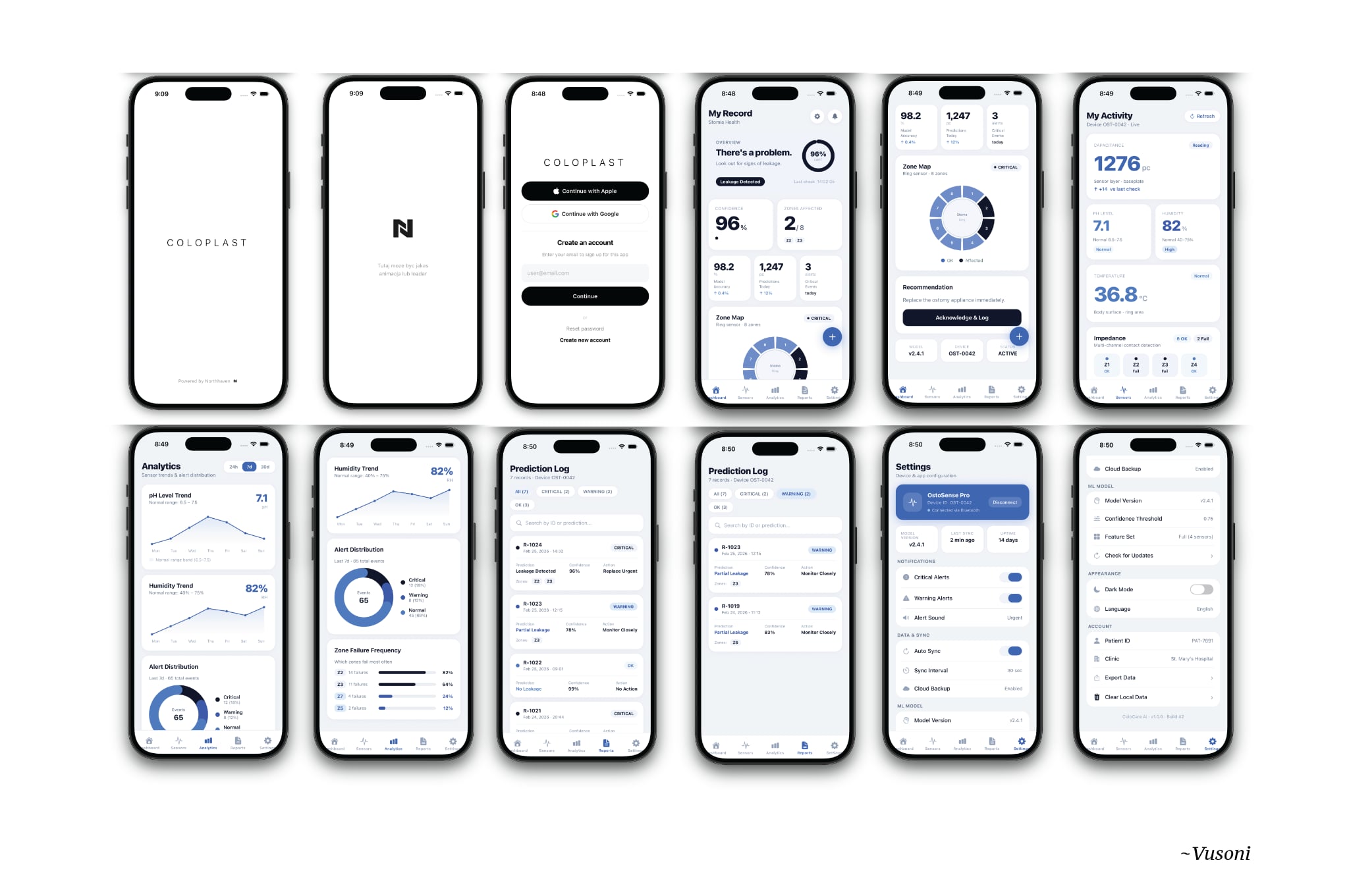
Our intelligence layer processes raw, complex sensory data into three simple, reassuring features within the patient application.
Predictive Failure Timer
45-minute advance warning
Skin Health Index
0–100 real-time score
Lifestyle Correlation
HealthKit & Google Fit
1. Predictive Failure Timer
Instead of frightening the patient with an ongoing leak alarm, our algorithm predicts the future. By analyzing time-series data (using LSTM neural networks), we calculate the saturation „velocity” of the material under the baseplate.
This allows the app to display a calming, highly accurate message: „You are safe. Estimated time until leak: 45 minutes.” The patient regains total control over their schedule.
Estimated time until leak: 45 minutes. The patient regains total control over their schedule.
2. Skin Health Index
Changes in pH and the growth of bacterial colonies alter the micro-conductivity of sweat on the skin. Our anomaly detection engine flags these invisible risks before physical pain or irritation occurs.
To avoid overwhelming the patient with medical jargon and millions of vectors, we condensed this massive data matrix into a single, simple score from 0 to 100. As long as the patient sees a high, green score on their screen, they know they are perfectly healthy.
3. Lifestyle Correlation Module
Medicine does not happen in a vacuum. What we eat and how we move has a massive impact on the lifespan of medical equipment.
We natively integrated our system with Apple HealthKit and Google Fit. The algorithm correlates the patient’s heart rate, burned calories, and logged meals with the degradation data from the Coloplast Heylo hardware. The app can generate precise insights: „We noticed that intense running at temperatures above 25°C accelerates your baseplate wear by 40%.”
Edge AI: Privacy and Reliability First
Life-supporting health systems cannot rely on cellular network coverage. Expecting a patient to have a perfect LTE signal while hiking in the mountains or flying on a plane is a fundamental design flaw.
That is why we implemented an Offline-First architecture. We compressed our powerful machine learning models (TinyML) so they can run locally, directly on the processor of the patient’s smartphone (Edge Computing).
As a result, there is Zero Cloud Lag, and the patient’s highly sensitive physiological data never leaves their device without explicit consent, guaranteeing absolute security and privacy.
Offline-First Architecture
TinyML models run locally on the smartphone processor. Full functionality without LTE — mountains, planes, anywhere.
Zero Cloud Lag
No delays from server communication. Real-time predictions and alerts, instantly on device.
Absolute Privacy
Sensitive physiological data never leaves the patient’s device without explicit, informed consent.
TinyML On-Device
Compressed neural networks trained on millions of Digital Twin synthetic scenarios, running locally.
Summary: The Future of Medical Hardware is Software
The „Intelligence Layer” project for the Coloplast Heylo device proves that innovation in medicine doesn’t always require building new machines. Sometimes, it just takes looking at the exact same data through „smarter lenses.”
Applying advanced analytical algorithms from the FinTech sector to bodily sensor readings allows us to transition from reactive medicine to 100% predictive medicine. At Northhaven Analytics, we believe that software is the ultimate cure for patient fear and uncertainty.
Northhaven Analytics
Software is the ultimate cure for patient fear and uncertainty. Contact us to learn more about The Intelligence Layer.
Get in Touch →